Survive and Thrive: Tamar Kintsurashvili
Conversations about the survival of public-interest media
In many parts of the world, free media are fighting a desperate battle against repression, censorship and threats, a lack of funding, competition from digital platforms and an increasing loss of trust.
Survive and Thrive seeks to equip listeners with a deeper understanding of the forces shaping media and to spark meaningful conversations about how we can all support and sustain a free and independent press.
New moderator duo

For the third season of Survive and Thrive, a new moderator joins the team: Imani Henrick Luvanga is a journalist, former radio station manager, and a DW Kiswahili reporter from Tanzania.

She’ll moderate the podcast together with Janelle Dumalaon, host since season one, and a DW correspondent in Washington.
Episode 1: A story of hope and resilience
Ahead of the DW Global Media Forum, we spotlight a success story in an increasingly hostile environment. A media organization in Georgia has found ways to thrive against the odds.
The story of Tamar Kintsurashvili and the Media Development Foundation (MDF) reminds us why independent journalism matters and inspires hope for the future of public-interest media.
Imani Henrick Luvanga: Hi, everyone, and welcome to another season of Survive and Thrive – the podcast where we explore the challenges and breakthroughs in public interest journalism. I am your new host, Imani Henrick Luvanga.
In this season, we're diving deep into what it really means to not just survive in the world increasingly hostile to press freedom, but to thrive. Around the globe, media organizations are facing intense political pressure, funding shortfalls, legal click downs and an erosion of public trust. And yet, amid these storms, some are finding ways to stand firm and even grow stronger.
In our season opener, we dive into a story of resistance: We are heading to Georgia, a country that once promised press freedom, but where the media landscape has darkened in recent years, especially with the introduction of a controversial "foreign agent law".
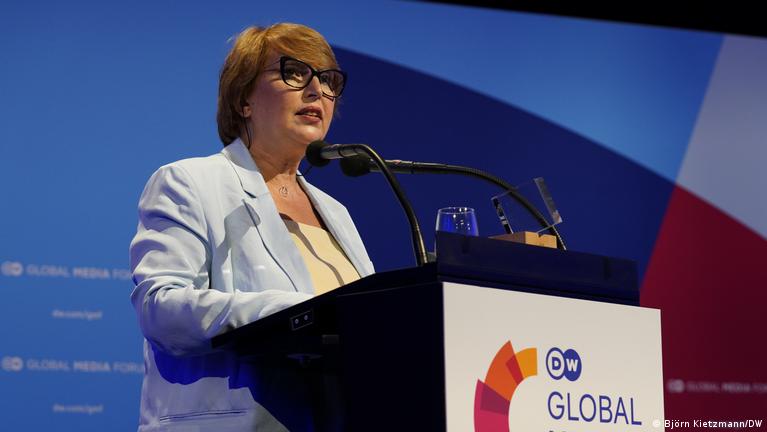
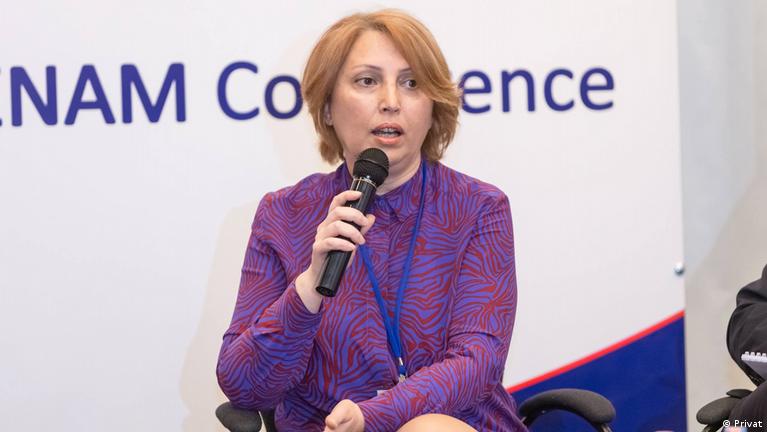
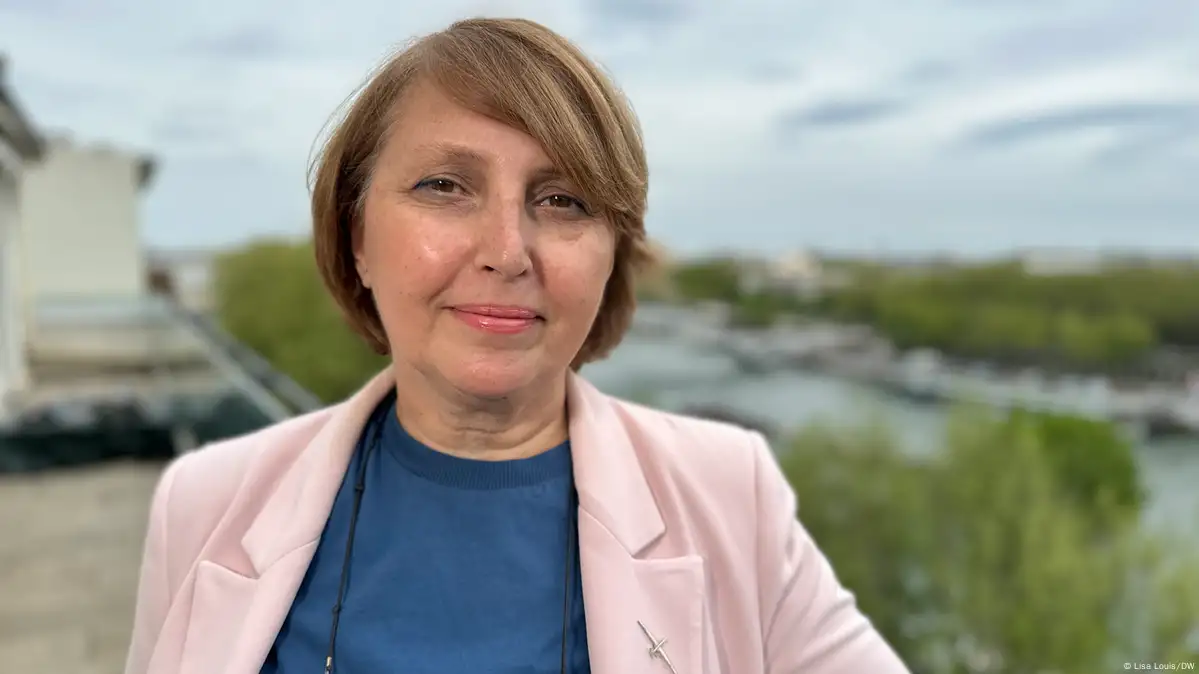
Our guest today is Tamar Kintsurashvili, Executive Director of the Media Development Foundation and this year's recipient of DW Freedom of Speech Award. Her organization has become a beacon of resistance, fighting disinformation, pushing back against the authoritarian drift, and refusing to be silenced.
First, congratulations on the DW Freedom of Speech Award. What does this recognition mean to you and your team at MDF?
Tamar Kintsurashvili: Thank you very much. It's an honor to receive the DW Freedom of Speech award this year. The work we are doing is to keep the media ecosystem healthy and to protect it from hostile actors and disinformation. The award is recognition of this work, and it encourages us to continue what we’ve been doing for a long time – especially today when we are facing existential threats. Civil society organizations, media outlets, and all democratic institutions are experiencing pressure from the increasingly repressive legislation in our country.
Tell us more about the Media Development Association and what it does.
The Media Development Foundation was created in 2008 by professional journalists to support the development of media. We later started fact-checking to address the spread of disinformation, whether it's foreign or domestic.
We also study hate speech because this is not only a freedom of expression issue but a security issue. Hostile actors are trying to create clashes between people depending on their ethnicity, religious beliefs, gender identity, and this might turn into conflict.
We aim to counter that with media literacy work and started working with DW Akademie on programs that are tailored not only to journalists and the media, but also media consumers.
Today, any citizen can create media content and it's important to understand that it’s everyone’s responsibility not to spread mis- and disinformation. We have many alumni who are now engaged in citizen journalism and education. This way, we try to build a more resilient society and realize the responsibility of everyone in this process.

Georgia's media ecosystem has experienced a substantial erosion of press freedom. How do media outlets react to this? Which strategies do you see?
This time is very critical for Georgian media and civil society. Over the last year, our government passed 16 repressive laws. One of them restricts foreign funding for broadcast media. Another – you already mentioned it – is the “foreign agent law” making it compulsory to register as a foreign spy if you receive funding from abroad.
Western countries are supporting democratic initiatives to strengthen Georgia’s democratic institutions and support the country on its way to EU membership. We need to be part of the European family.
This law is specifically tailored to undermine trust in our operations because the media need trust. If you are labeled a foreign spy serving different countries, this undermines your credibility and that’s unacceptable for us. That's why key media and civil society organizations filed a complaint at the European Court of Human Rights.
Just today, the government started enforcing this legislation against watchdog organizations like Transparency International and Georgia Open Society. They – illegally – requested personal data of beneficiaries. That’s a problem because people trust our activities and revealing this data would undermine their activities as well.
So, the media tries to find different ways to survive. Some of them register their organization abroad – but transferring money is a problem. Crowdfunding and different sources of income are considered for survival in this difficult situation. But the main issue is how to preserve watchdogs on the ground. For democracy we need independent functioning institutions – and for authoritarian leaders, democracy is a threat. That's why they are fighting their own people, their own institutions rather than against countries that are invading our territory. They are more focused on destroying democratic institutions rather than ensuring security for all citizens.
The "foreign agent law" has created a chilling atmosphere, right? So why has MDF decided not to register? And what does that decision mean for your organization and your personal life?
We truly believe that we serve Georgian people rather than foreign countries, and we care about our credibility. When we receive funding, for example from DW Akademie, it's for Georgia to be more resilient toward foreign information manipulation and domestic information.
We're using financial support to make Georgia a better country rather than to serve the interests of others. Our goal is to inform Georgian citizens. In a democracy, you need reliable information to make good decisions.
We’re an obstacle for the government that tries to manipulate public opinion using propaganda, troll factories and even public servants who should serve Georgian citizens during working hours. They are engaging propaganda against journalists, media outlets, opposition and civil society actors trying to present us as enemies of the country. This reminds me of Stalinist times when people were denounced as enemies, critical voices in our society. Many well-known writers and poets were imprisoned because they were a threat to the Soviet regime.
This toxic environment is dangerous for society, and it makes our work very difficult.
When the government targets you personally, not just as a journalist but as a citizen, even a parent, how do you cope? Where do you draw your strength from?
I'm trying to be transparent about this threat and to show that we are not afraid. Transparency is the best thing you can do against a repressive government.
I’ve been receiving threats over the past years, by email, phone calls, they came near our offices, vandalized our office, they called my family members – and I was talking about this online. We published the recording of the security camera showing masked strangers who came around midnight to put up posters calling us liberal fascists and saying there’s no place for us to stay in this country.
Social media helped us to consolidate support; many strangers from around the world support us. We are not afraid; we are transparent and consistent in our actions. We continue to inform Georgian people and do our professional work. Even if the government’s goal is to destroy our operations at home.
For other media managers in a hostile political environment, what are your lessons on balancing resistance and safety, mission, and survival?
Media outlets are united right now. We, as part of a media coalition are trying to support them professionally, provide them with assistance in terms of cyber security, because they are experiencing cyber threats, as well.
Financial sustainability is also crucial. Right now, it's not only the cutting of funds coming from the USA that’s difficult, but also how to receive funding in Georgia because of this restrictive legislation. And they will never allow for funding independent media outlets which are not controlled by the government. Their goal is to clean the space from remaining independent institutions in Georgia. The media plays a crucial role here.
Actually, broadcast media are in a very poor situation. I would say most of them are moving their journalists to YouTube channels because there are no sufficient financial sources and the government controls the majority of influential TV channels. We have a similar situation between opposition affiliated neutral media outlets and government affiliated media outlets. That's why they're trying to dominate the public sphere and even small media outlets are a threat to them.
What you have said, Tamar, gives us the picture that so many public interest media outlets are in survival mode. What does thriving mean to you in this context?
In this context, thriving means that we – civil society organizations and media outlets – should consolidate our efforts to survive. It might be useful in case of freezing accounts or moving outside of the country. No one wants to do that right now. We have seen a similar scenario in Russia and Belarus – and many journalists are in exile in Georgia.
For a long time, Georgia was a safe space, but not anymore. [Journalists and civil society actors] are banned from entering the country. We need to act together to save what we have achieved so far.
And what concrete strategies or decisions have helped the MDF to remain resilient, from funding to partnership staffing or digital tactics?
We combine different methods. Last year we launched our organization in Estonia because it’s easy to register in an EU member state – even though I have never been to this country. And we are working closely with our international partners to put pressure on the government in response to this repressive legislation. Also, we’re transparent in our actions.
I think documenting and monitoring repressions in Georgia is most important, so we cooperate with international watchdogs to make our case. We filed complaints to document everything, because the European Court of Human Rights must decide on the “foreign agent law”. Georgia is a member of the Council of Europe. Two years ago, we hoped to become a member of the European Union when we celebrated candidate status. But unfortunately, since then our government abandoned their commitment to democracy and they are undermining our membership to the EU, which would be a window of opportunity for Georgia.
It's sad to look back on how we were developing all democratic institutions for a long time, coming closer to the European family. And now we are backsliding, and copy-pasting Russian legislation; our government enforces Russian-style practices. In Russia, Transparency International was forbidden. And two days ago, Georgia launched an investigation against Transparency International, which does a lot of work in support of media outlets here, investigation of corruption and abuse of power by the government.
Looking back, were there any warning signs of the political turn in Georgia? And maybe if there was any, what would you say to media managers in other countries who see similar signs emerging?
Unfortunately, we see that similar legislation is initiated even in EU countries like Hungary. It’s creeping authoritarianism. You think it does not concern you, but one day you realize that it might happen everywhere.
We were working with journalists in exile in Georgia, training them in fact-checking, among other things. Now, they teach us how to survive in a hostile environment because you never know what could happen.
I think we need unity against these trends and even in established democracy we are observing alarming changes. It was difficult for me to imagine that I would ever support Radio Liberty or Voice of America against their own government, but it is happening. It’s more difficult for us because we are a post-Soviet country without an independent judiciary. But in established democracies, the judiciary works. We should share our experiences with each other; we should learn from each other and develop better strategies to save democracy.
Democracy is under attack everywhere and unity, consistency and monitoring this repression is something that we can do together.
How do you handle the pressure of calling falsehoods where they often come from those in power? Can the media still act as watchdogs in an era of manipulated information?
The media can of course still act as watchdogs, and we should empower media outlets and protect individual journalists!
First of all, we need to differentiate trustworthy, public-interest media from those trying to manipulate public opinion. That's why we need fact-checking, research, and naming and shaming those who abuse democratic institutions like media against democracy. We need to create an environment where public-interest media can operate without barriers and obstacles. And the media ecosystem needs to rethink its approaches and funding opportunities as well, because without funding it's difficult to preserve.

What role can independent media play in fighting back against disinformation, especially during election seasons – and what are the limits?
The limits are related to operational challenges, like legal barriers as in Georgia or limited funding opportunities. Powerful actors controlling media outlets have more resources. For them, media are not only platforms to inform but also for entertainment. In Georgia, TV is the main source of information and we have a concentration of the big TV channels. That makes it difficult to compete.
We have unequal conditions for government-controlled media outlets and smaller ones. They were constantly in survival mode – even more so when donor assistance was more project-related, which makes long-term sustainability difficult.
I think there was some gap in understanding the needs for media development properly and sometimes there were overlaps because of the project-related approach. Many training courses on the same topics, much funding on the same topics. Donor coordination is important to address the real needs of the media at the right time.
What's your expectation for Georgia's media space? Are there any signs of hope or are we looking at a longer struggle?
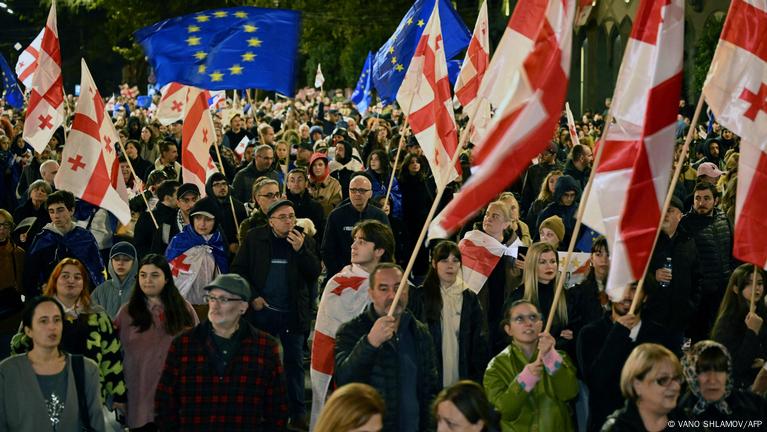
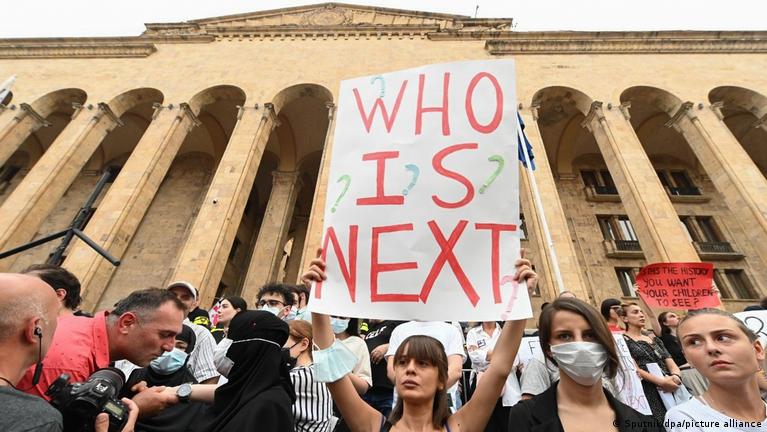
The future of media depends on the overall democratic situation in the country. It depends on the survival of civil society actors and the resilience of Georgian society. It's not clear right now, but the public continues protesting in the streets in support of key civil society actors and against the government decision to postpone our EU integration until 2028.
Being a member of the EU would mean commitment to democratic reforms. That's why our government undermines this process. People are protesting because they fear there will be no other possibility in the near future if this window is closed for Georgia alongside Ukraine and Moldova which are progressing and coming closer to EU membership.
In a moment of democratic backsliding like this, what role do you think public interest media should play in sustaining democracy?
Public-interest media inform society about issues that are not accessible on government-controlled channels, for example investigations about the abuse of power, or in-depth reporting about issues of public interest.
Journalists who hold powerful people accountable are under threat because they are serving the public, not autocrats, not governments. It's not the duty of journalists to produce the story that pleases those who are in power. That's why they are under attack. And government propaganda undermines trust in independent media outlets as well. They are creating parallel institutions – their own fact checking, their own media, self-regulation bodies – because they don't like the content created by independent media outlets and watchdogs.
Thank you, Tamar, you have done an incredible job in Georgia, not just for you, not just for the journalism industry, but for the Georgian people. What gives you hope to keep going even when it feels impossible?
My colleagues’ courage, their dedication to their work and the hope that Georgia will one day be part of the European family. Like our predecessors, we have been hoping and fighting for this future for a long time.
Now is not the time to abandon our dreams about the bright future of our country. Our partners’ support also encourages us to remain in fighting mode.
Before we close, if you could speak directly to media managers who are facing their own challenges, what one piece of advice or encouragement would you want to leave them with?
Continue doing the good work, despite pressure coming from those who are in power. Power resides in people, and information is a source of power. I think our voices should be heard and we should talk with the public directly and not change our editorial policy. No matter who is in power, information is needed for well-informed citizens.
Thank you so much, Tamar. I wish you all the very best!
Thank you.
This transcript of "Survive and Thrive" has been lightly edited for clarity.
Get in touch
For questions and suggestions write to dw-akademie.surviveandthrive@dw.com
Or find us on LinkedIn and Youtube.
This podcast is produced by DW Akademie and is supported by the Federal Ministry for Economic Cooperation and Development (BMZ).
The podcast is produced by DW Akademie and is supported by the Federal Ministry for Economic Cooperation andsurvive and thrive Development (BMZ).
The Media Development Foundation (MDF) is a DW Akademie partner in Georgia. It is training young people from Armenia, Azerbaijan, Georgia and Ukraine to uncover and report on propaganda and disinformation, and holds an annual international fact-checking conference to promote networking and a professional exchange between Georgian media professionals and international experts.