Uzbek scientist explores climate change, gender inequality

Barnokhon Artikkhodjaeva was working as a biotechnologist in a lab during the COVID-19 pandemic. She fortunately escaped catching the illness – at first. Her busy days were spent analyzing patient samples, but at the same time, she was observing the pandemic's broader effects. One positive – outside the lab – was how healthcare funding in Uzbekistan, where she lives, increased exponentially. A can-do spirit and that ever-elusive political resolve took hold across the Central Asian nation. Mobile hospitals and public assistance led to, as she calls it, "a profound lesson in social cohesion."
This watershed moment, she said, prompted her to wonder what else was changing as a result in Uzbekistan. As soon as she recovered from her own COVID-19 bout, she decided to hit the road, away from Tashkent, the capital, to see how others were faring. In short, she realized: not good.
"There are significant gaps between Tashkent and the rest of the country," she said. Paramount among these gaps is access to clean drinking water, quality medicine and education, compounded by high unemployment. These circumstances led her to rethink her line of work, and in short order, she returned to school to study sociology and gender.
Her biotechnology degree gives her a firm scientific foundation in environmental threats and her sociology credentials help her address the social and gender-specific impacts of a changing climate. As such, she has served as an expert at DW Akademie trainings on how media cover gender and climate change.
Two tough fields
Barnokhon Artikkhodjaeva's professional credentials, without question, pack a wallop. This is particularly true in Uzbekistan, where social stigma and subtle condemnation prevent women in rural areas from pursuing careers. Today, Artikkhodjaeva is a skilled regional expert trainer on gender and climate change which, at first blush, might not seem related. In fact, she said, they are.

Barnokhon Artikkhodjaeva pairs her scientific education and experience with social inequality in Uzbekistan and helps journalists connect the two in their reporting.
"Gender and environmental expertise are important and evolving fields in Uzbekistan," said Christina Sell, DW Akademie project manager, who noted, too, that Artikkhodjaeva has served as a consultant to the World Bank.
"My role has been to bridge these complex areas and equip journalists with the tools to cover them responsibly and constructively," Artikkhodjaeva said. "I focus on the ethical and accurate integration of climate change and gender issues into their reporting and help media clubs foster dialogue and best practices between activists, media and other experts."
"A real discovery for our team"
DW Akademie works with the Center for the Development of Modern Journalism in Uzbekistan on the project “EU Tabassum: Media Skills to Promote Gender Equality and Empower Young Women in Uzbekistan," which aims to enhance the expertise and practical skills necessary for reporting on gender inequality, gender-based risks and solutions that address these issues. The Center invited Artikkhodjaeva to the first gathering in September 2024. There, participants learned that women are among the most vulnerable to floods, mudflows and other climate-related disasters. She then went on to regularly train Uzbek journalists on gender reporting, and consistently receive enthusiastic feedback, such that she also grew interested herself in the art of reporting.
"Barno became a real discovery for our team," recalled Lola Islamova from the Modern Journalism Development Center (MJDC) in Tashkent. "She combined expertise in both environmental and gender issues, and she also expressed a strong desire to develop her own media project but lacked media management experience."
Eventually, Artikkhodjaeva applied to attend the Media School Uzbekistan, which is an annual capacity-building program for both media managers and journalists, implemented in partnership between MJDC and DW Akademie.
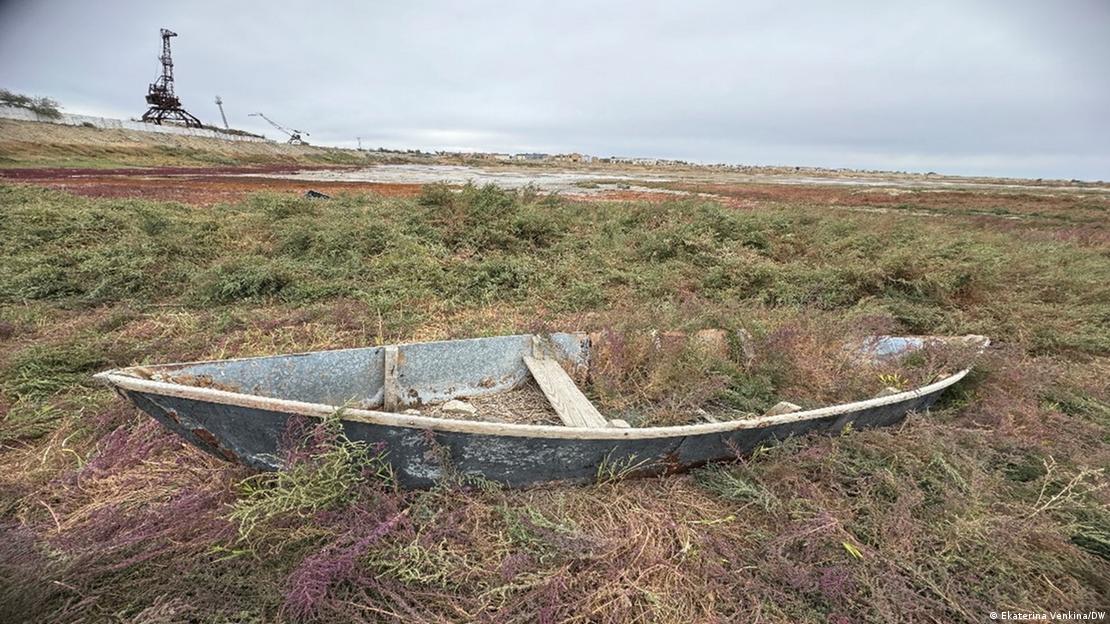
Artikkhodjaeva has her work cut out for her, as Uzbekistan faces numerous environmental challenges, particularly in terms of water scarcity. Landlocked and geopolitically strategic, the country is entirely dependent on transboundary rivers. The national economy is based largely on agriculture and international surveys suggest that water scarcity will only grow due to increased population and global warming. Already, respiratory, allergic and cardiovascular diseases are serious public health problems.
Artikkhodjaeva has expanded her consulting in Uzbekistan to other Central Asian countries and has also advised the World Bank on her country’s resources and climate change.
In terms of gender, women in Uzbekistan traditionally secure water, food and fuel for their families. Worsening droughts, floods and land degradation mean women must spend more time figuring out how to get such basics – time that could be spent on education or paid employment. Things like crop failure and loss of livestock also can put pressure on household economies and, Artikkhodjaeva noted, can lead to domestic violence. Moreover, women often have less access to information on climate risks, credit or land ownership.
Women and climate change
"The primary indicator of success here [in Uzbekistan] has historically been economic and quantitative metrics," Artikkhodjaeva said, "while social contribution, sustainability and citizen well-being often remain at a secondary level of priority.
"Climate change and gender are not simply two separate issues," she continued. "They are deeply interconnected phenomena. The climate crisis is not neutral; it disproportionately impacts social groups that are already vulnerable, which in most societies means women and girls."
But therein, she thinks, lies at least one key to helping alleviate Uzbekistan's climate concerns.
"Women are key to successful adaptation," Artikkhodjaeva said. "They possess unique traditional knowledge about resource conservation, seeds and water management."
Her work, she added, helps her to be a part of the solution.
"When confronted with systemic challenges and inertia," she said, "I feel a deep sense of commitment, but also realize I cannot change the entire system overnight. I can be a catalyst and help initiate a chain reaction of change."
"EU Tabassum: Media Skills to Promote Gender Equality and Empower Young Women in Uzbekistan" is funded by the European Union and co-supported by the German Federal Ministry for Economic Cooperation and Development (BMZ). It is implemented by DW Akademie and the Modern Journalism Development Center (MJDC) in Tashkent. Media School Uzbekistan, or MSU, is a partnership between the Modern Journalism Development Center (MJDC) and DW Akademie, and is funded by Germany's Federal Ministry for Economic Cooperation and Development (BMZ).