Students take the express train to media literacy in Ukraine

High in the Carpathian Mountains in Ukraine, high school students scan a list of tasks. The assignments range from grouping their peers according to their eye color to arranging each other by height. With a three-minute deadline, the group immediately gets to work, the room a frenzy of activity. Yet a few students stand still, seemingly unaffected by the commotion around them.
After most of the tasks are completed, the students begin to groan and laugh. At the bottom of the list, the last item reads: “Ignore the previous tasks and just do nothing.”
Earlier this year, these school children were participating in a Media and Information Literacy training from the Ukrainian national railways with Pavlo Mantulo, a cybersecurity expert. He used the exercise to underscore the importance of analyzing information and not jumping to conclusions. The task illuminates how easy it is for people to get swept up by their environment and respond to demands for their attention.
Mantulo noted that the students found themselves too busy feeling the pressure of the task to think critically.
“The ability to choose reliable information resources, distinguish between emotional and manipulative texts and to think critically is extremely important,” Mantulo explained.

According to Mantulo, teenagers are one of the groups most vulnerable to fraudsters and disinformation. During his trainings, students have been especially interested in personal data protection and fighting cyberbullying.
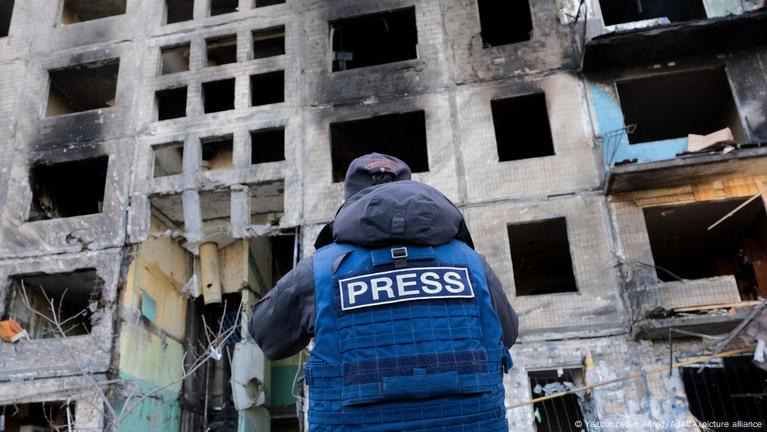
Trainers like Mantulo teach teenagers regularly as part of DW Akademie’s work in the country. As the country passes the three-year mark of Russia’s full-scale invasion, the needs of Ukrainian citizens have changed – from needing access to information – to dealing with the everyday realities of living under wartime conditions.
Training by train
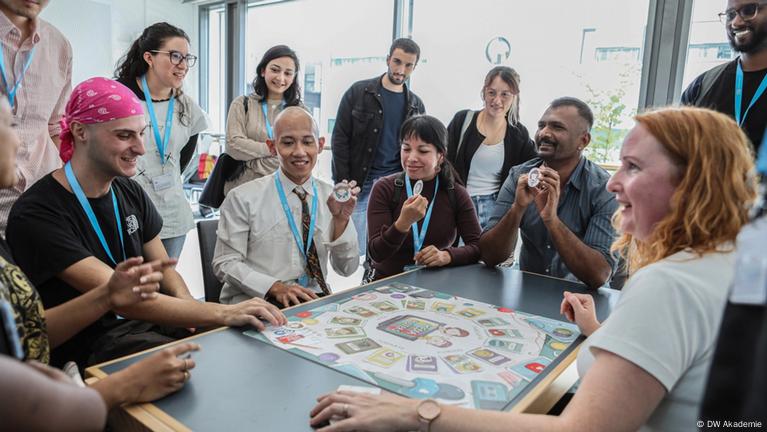
DW Akademie and its partner, Ukraine’s public broadcaster Suspilne, have responded to the new needs of the country with MIL trainings. In this novel program, students are brought in from across Ukraine to the Carpathians, one of the country’s few regions that has not been the target of Russian attacks. There, the 10–17-year-olds participate in games and trainings.
Organized by Ukrainian Railways, participation is free for children, many of whom live in the eastern oblasts and who are looking for a break from the pressure of being both a teenager and a teenager in a war-torn country.
According to Vladyslava Misna, project manager for Suspilne, these skills are useful not just in identifying Russian propaganda, but in identifying phishing schemes, along with learning how to prevent and respond to cyberbullying.
“At the moment, many of the kids are emotional,” Misna said. “This means they make decisions really quickly, so we are teaching them tools.”

Eurovision and MIL
Trainer approaches vary greatly, from deep fake identification to TikTok tutorials. Yet Suspilne is mostly known among young people for Eurovision. The public broadcaster is the organizer for national selection and leads coverage of the event. Some of the trainers are also influencers, an appealing job for a generation of digital natives. And the European event’s big international stage is therefore naturally appealing to youths.
“It is also a national celebration of something beautiful,” Misna said about Eurovision – a chance for youths to think about anything other than the conflict.

Their hardest years
For the European Union-funded project, the goal is to reach 2,500 students, with more than 1,000 students already receiving training. Many of these youths will then go on to take master classes with other DW Akademie trainers to reinforce their MIL skills.
But to train the young students successfully, the trainers have to be sensitive to their needs, as many of them have been uprooted from their homes or recently lost one or even both parents in the war.
“They are living their hardest years,” Misna explained. “They have been through things most grown-ups will never have to go through.”
For this reason, the trainings are conducted with a child psychologist on hand, as many of the students struggling in and out of school.
“This is the pandemic and war generation,” said DW Akademie project manager Yulia Alekseeva. “Some of the kids at ten cannot read, some do not speak.”
This level of trauma is not something that can be solved in a couple of weeks away from danger. Yet the space does allow for at least a short reprieve from the stress of their daily lives.
It is part of a larger approach for Suspilne and DW Akademie, one that looks to Ukraine after the end of the war.
“We want to raise a generation of conscious and aware Ukrainians,” said Misna. “They are the foundation of Ukraine’s future.”
Media literacy in the curriculum
To work toward a more reflective Ukraine, Mantulo noted that these kinds of training opportunities should happen more often.
“They should take place not only at the level of individual organizations, but at the state level as well,” he said.
Incorporating MIL into school curricula hasstarted to be implemented in neighboring Moldova, with the help of DW Akademie and their partner Independent Journalism Center. One of the Ukraine team’s goals is to complement state school curriculum with educational content and interactive approaches for classroom work with MIL in Ukraine as well.
“With so much that students face online and in real life,” said Alekseeva, “We want to make sure that all students in Ukraine have the skills to navigate online spaces safely and responsibly.”