Three years into the war, media look to Ukraine's future

It’s the first day of school in Ukraine and children are celebrating Knowledge Day. Girls are wearing traditional Ukrainian dresses, teachers are holding flowers and children are clasping onto their balloons and singing. A shrill air raid siren cuts through the festivities and the children file into the bunker. One child starts sobbing but the others continue singing unfazed, balloons bouncing harmlessly off the bunker's cement walls.
It's a scene from Kateryna Gornostai’s new documentary, “Timestamp,” which premiered last week at the Berlinale Film Festival. The Ukrainian director describes her film as a “patchwork quilt” that follows multiple Ukrainian schools as the students and teachers carry out everyday lives under extraordinary circumstances.
Supported by DW Akademie’s EU-funded MediaFit program and Canal France International, the documentary explores a new reality of the war in Ukraine. Since Russia’s full-scale invasion on February 24, 2022, Ukrainians have somehow adapted to a “new normal” among the ruins and threat of attack.

Shifting focus
The changes to their lives are also reflected in DW Akademie’s collaborations with local partners. These programs no longer focus predominantly on survival but on the future of Ukraine – and the role that media will play.
At the start of the war, DW Akademie and its partners concentrated on providing equipment and grants to keep media outlets going - efforts that were funded by the European Union (EU) and Germany’s Federal Ministry for Economic Cooperation and Development (BMZ). Although the programs still provide funding for key media organizations, new projects concentrate on the nation’s future.
“For the first two years, the focus was on how Ukraine could survive. It was all about resilience,” explained DW Akademie project manager Yulia Alekseeva. “The trend now is how Ukraine can be part of European society.”
Upcoming generation
One way is to look towards Ukraine’s next generation. The “Iron Squad” program, a free camp organized by Ukrainian Railways, brings young people from across Ukraine to the Carpathian Mountains – one of the country’s few regions that has mostly avoided bombing. There, the youth escape the everyday struggles of not just being a teenager, but of being a teenager in a country at war.
As part of the camp, DW Akademie and the public broadcaster Suspilne offer trainings to the students.
“Many of these kids were relocated from the occupied territories and have parents who are currently fighting or are orphans,” said digital security expert Pavlo Mantulo. “The camp is essential for these kids.”

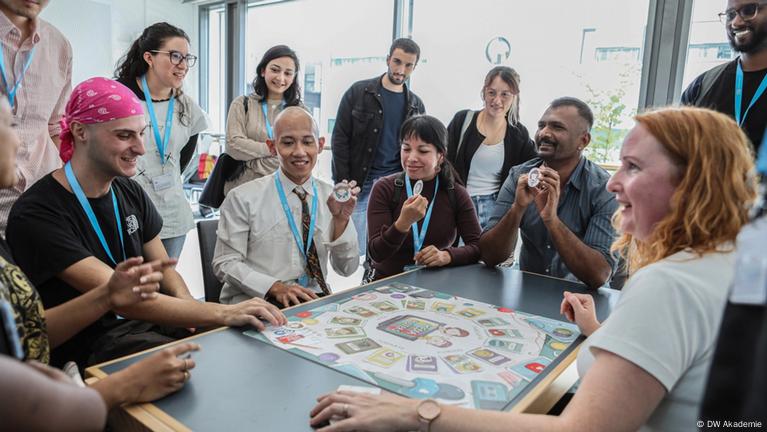
So far, more than a thousand young people between the ages of 12 and 17 have attended a training through the camp. They learn about media and information literacy (MIL), and always with a youth psychologist on hand. The trainings cover everything from securing their online accounts to avoiding scams to detecting misinformation. The trainings take an interactive approach with games, and some participants even learn how to cover the Eurovision.
“We want youths to think and analyze, especially now, during the information war that’s been going on for the past three years,” said Vladyslava Misna, project manager for Suspilne Juniors. “We want a conscious nation in the future.”
Still, critical thinking is not just for students. The BMZ-funded project also looks to help older people develop the same skills but uses different approaches. Starting in March, Ukrainians over the age of 60 can take MIL classes and learn digital skills to help them safely access the information they need.
A viable media
Imagining Ukraine in a post-war environment also means looking at the media sector’s financial struggles. Over 90 percent of Ukrainian media houses have been affected by the freeze of USAID, America’s foreign aid agency. DW Akademie’s EU-funded program provides crucial funding for key outlets in southern and eastern Ukraine and trains media outlets through the Lviv Media Forum. The project also supports the public broadcaster Suspilne as its continues to develop as a national organization with a series of regional outlets throughout the country.
However, media outlets are only as strong as those who work for them. Therefore, DW Akademie has organized BMZ-funded retreats for media professionals to come to Germany to reflect on their work. It also gives them an opportunity to step back and connect with other colleagues.

These retreats also offer participants a broader perspective. During the retreat held in November, 22 media workers were able to meet and have an exchange with the president of the European Parliament, Roberta Metsola. At the upcoming retreat at the end of February, another group will meet NATO’s strategic communications team and Germany’s ambassador to NATO, Dr. Géza Andreas von Geyr.
A postwar Ukraine
The dream of joining NATO and the European Union remains strong for many Ukrainians, in which democracy is fundamental. And for democratic values to flourish, the country requires both a stable media sector and information integrity. With this goal in mind, DW Akademie’s Ukrainian partners are looking toward a future where Ukrainians can be and feel safe once again.
DW Akademie’s work in Ukraine is funded by the European Union, the Federal Ministry for Economic Cooperation and Development (BMZ), and the German Federal Foreign Office.