Georgia's independent media struggle for survival

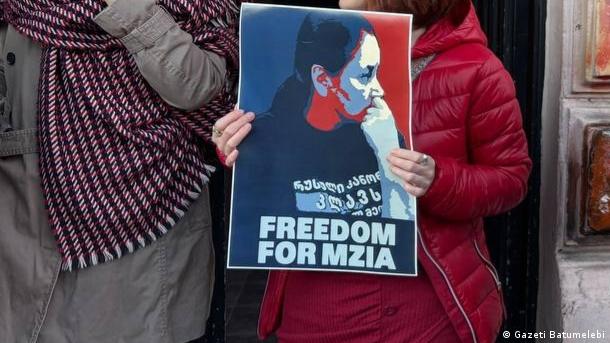
Founded in 2001, Georgian independent media organization Gazeti Batumelebi today operates two online news sites, Netgazeti and Batumelebi. The latter, which covers the country’s Adjaria region, is a government target, and one of its founders, Mzia Amaglobeli, was arrested in January during anti-government protests on charges of assaulting a police officer. Observers say her arrest was politically motivated. She now faces up to seven years in prison.
"Unfortunately, Mzia Amaglobeli is not the only member of our media team detained right now,” said Irma Dimitradze, a Batumelebi journalist and communications manager. “Right after Mzia's arrest, our cameraman, who was simply filming the protests, was also detained.”
Batumelebi was one of five regional and local media organizations in Georgia to work with DW Akademie as part of the EU-funded Quality Media and Conscious Media Consumption for Resilient Society (ConMeCo) project. The idea behind the partnerships is to provide quality information to Georgians during the Parliamentary pre-election and election periods in an extremely polarized and politicized environment, enabling voters to make informed decisions.
Cultural and historical roots of contemporary narratives
Social repression characterized everyday life in the former Soviet Union. Under Josef Stalin’s regime, millions of free thinkers and system opponents were exiled to the Gulag, a vast labor camp system, for both real or fictious crimes and dissent, or else citizens were detained as disinformation propagators. While the methods may differ from those used today, the essence of repression against independent journalism remains.
"The roots of today’s political environment and the issues we face lie in the 20th century, in the Soviet Union, “said Tornike Nozadze, project coordinator at At.ge, a DW Akademie partner in Tbilisi which focuses on cultural and historical matters in Georgia. “Technically, we became independent after its collapse, but we are still in the process of liberating ourselves from it.

At.ge’s pre-election counter-disinformation initiative consists of an educational video series with a retrospective look at history; a "Let’s Talk" video series addressing fake news entering the country from Russia; articles on political exiles; and a short documentary film about Soviet repression in 1937.
"The approach has been to remove and hide the names of those who fled or were sent to gulags during the Soviet era, leading to a collective forgetting of our past,” said Nozadze. “What we do is reveal that strategy of disinformation, allowing the true information to spread.
Initially, Nozadze and At.ge’s creative team were skeptical about historical relevance to contemporary events. However, after the recent protests and the violent, hostile environment imposed by the regime, that belief has shifted.
Exposing corruption in Georgia
During the Parliamentary pre-election period in 2024, Georgia’s independent media reported on local and regional corruption cases that relate directly to the ruling “Georgian Dream” party.
“We were investigating the connection between a construction company that won tenders worth millions to renovate housing and municipal infrastructure,” said Nino Bakradze, editor and co-founder of the Investigative Journalists' Team iFact, a DW Akademie partner in Georgia’s Imereti region “However, after interviewing residents of these small cities, we found reports of inadequate delivery of services and low-quality work.”

The reporting team also uncovered that these construction companies donated a significant portion of their tender revenues to the ruling party.
Thorough, independent investigations at the regional level are crucial. Given the similarity of everyday issues in remote areas, the findings of these investigations are not only relevant for that specific area but also for other small towns and villages across the country, especially when it comes to corruption cases. Furthermore, regional media are closer to the communities affected by the consequences of corruption, which are often overlooked by larger media.
This is difficult, for a few reasons.
“Investigating in smaller communities presents more challenges than in larger cities,” said Bakradze. “People here know each other, and most of the interviewees request that we do not reveal their identities because local government officials are likely to recognize them and their families.”
The government’s recent strategies have also made it even more difficult for investigative outlets to operate.
“The government has started to withhold information from the media,” said Bakradze, “and public agencies have become significantly secretive. In many cases, we have to ask friends to request information because they (sources) deny the media.”.
Independent media under siege
“Everything the current government does aims to destroy and exhaust independent media. We are only surviving thanks to our colleagues who view journalism as a mission,” said Dimitradze from Gazeti Batulembi. “The biggest challenge we face, apart from the physical and emotional threats, is the rejection from state institutions. They have essentially started depriving us of access to public information, which they are required by law to provide.”.
In addition to withholding information and keeping regional visits and public discussions secret from independent media, the ruling party and state officials spread disinformation about these outlets during the pre-election period. They have accused independent media of being conduits for foreign influence, an attempt to undermine the public’s trust in these organizations.
“Moreover, people are afraid of losing their jobs and social benefits if they give interviews to media like ours,” said Dimitradze.
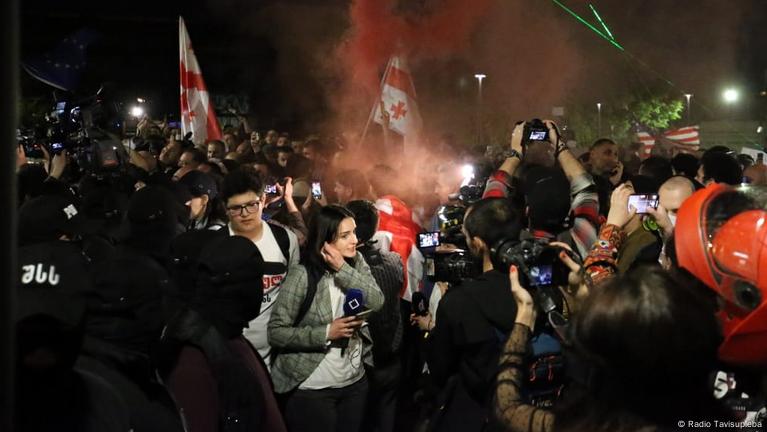
Despite the co-founder of Gazeti Batulembi, Mzia Amaglobeli, being imprisoned for more than two months, the organization continues to report on critical regional and national issues. Although the government has captured state institutions and eliminated nearly all opposition parties and members, protests persist because there remains a strong, independent media dedicated to disseminating truthful information.
“The only thing our government cannot destroy is the connection between the community and independent media,” Dimitradze continued. “Regardless of the threats they face, people recognize that regional independent media has been their voice for many years. This is certainly true for Batulembi, as well.”

Independent media struggles financially
Recent research published in our program revealed that independent media in Georgia is facing increasing violence,” said Nino Gogolashvili, the ConMeCo project’s lead manager. “This violence is exemplified by the unjust arrest of Mzia Amaglobeli, co-founder of our partner media outlet Batumelebi.”
However, sustaining independent journalism in Georgia requires more than just determination. The lack of funding, increasing restrictions, and targeted disinformation campaigns threaten its survival. As authoritarian tendencies rise, the need for a strong, independent press becomes more urgent than ever. Additionally, following the US presidential directive to suspend foreign assistance via the US State Department and USAID, dozens of independent media outlets, including Georgian media, have been severely affected.
"In the past, we would typically work on three projects simultaneously, but now we have no funding due to the US funding cuts,” said Nozadze at At.ge. “Everything we do now is driven by our enthusiasm, but unfortunately, I don't know how long we can sustain ourselves like this.”
"The media environment in Georgia is extremely polarized, especially now. Therefore, it is crucial to support independent media that is free from political influence," concluded Gogolashvili, adding, “their work is not just about reporting—it is about providing objective and fact-based information.”
This article is part of the project 'Quality Media and Conscious Media Consumption for Resilient Society (ConMeCo)', implemented by DW Akademie in cooperation with the Media Development Foundation and the Human Rights Center, funded by the European Union in Georgia and co-funded by the German Federal Ministry for Economic Cooperation and Development (BMZ).
This publication was funded by the European Union and co-funded by the German Federal Ministry for Economic Cooperation and Development (BMZ). Its contents are the sole responsibility of DW Akademie and do not necessarily reflect the views of the European Union and BMZ.