USAID cuts: Radio program protects social cohesion

"You see the panic in people’s faces, people are hopeless, they don’t see a perspective. I don’t think in the history of Kakuma we have ever reached a situation like this," says Taphine Otieno, Content Development Coordinator at Sikika community radio project in Kakuma refugee camp in Kenya.
When in January this year US President Donald Trump announced shutting down the US Agency for International Development (USAID), it soon became clear that this decision would especially hurt the most vulnerable. Until then, the United States had been the world's largest humanitarian aid donor, giving approximately 43 % of all contributions recorded by the United Nations. Without prior notice, development projects across the world were without staff and funding. Many refugee camps relying on foreign aid for food, health, security and education services were hit hard. Kakuma was one of them, as the US had provided around 70 percent of the funding for the World Food Program in Kenya.
"Survival for the basic needs"
Kakuma refugee camp in northwest Kenya is home to more than 303,000 people from South Sudan, Sudan, Somalia and Ethiopia, as well as the Democratic Republic of Congo, Burundi and Rwanda, making it one of the largest refugee camps in the world. In 2020, DW Akademie and Film Aid Kenya started the audio platform Sikika that offers reliable information for those living in and around Kakuma.

Yiel Awat has been with Sikika for four years. One of twelve community reporters producing content for 225 listener groups across Kakuma, he gathers and discusses stories relevant to his audience. Awat came to Kakuma in 2015 from Yei River county in South Sudan as refugee himself and before his training with DW Akademie, had never entered a newsroom or worked in journalism. According to him, his past experiences witnessing how a community was being misled and deceived by the elite political class inspired him to join Sikika. He wanted to become a voice of reason, he said — so that people from his community could make informed decisions and reclaim their power through truth.
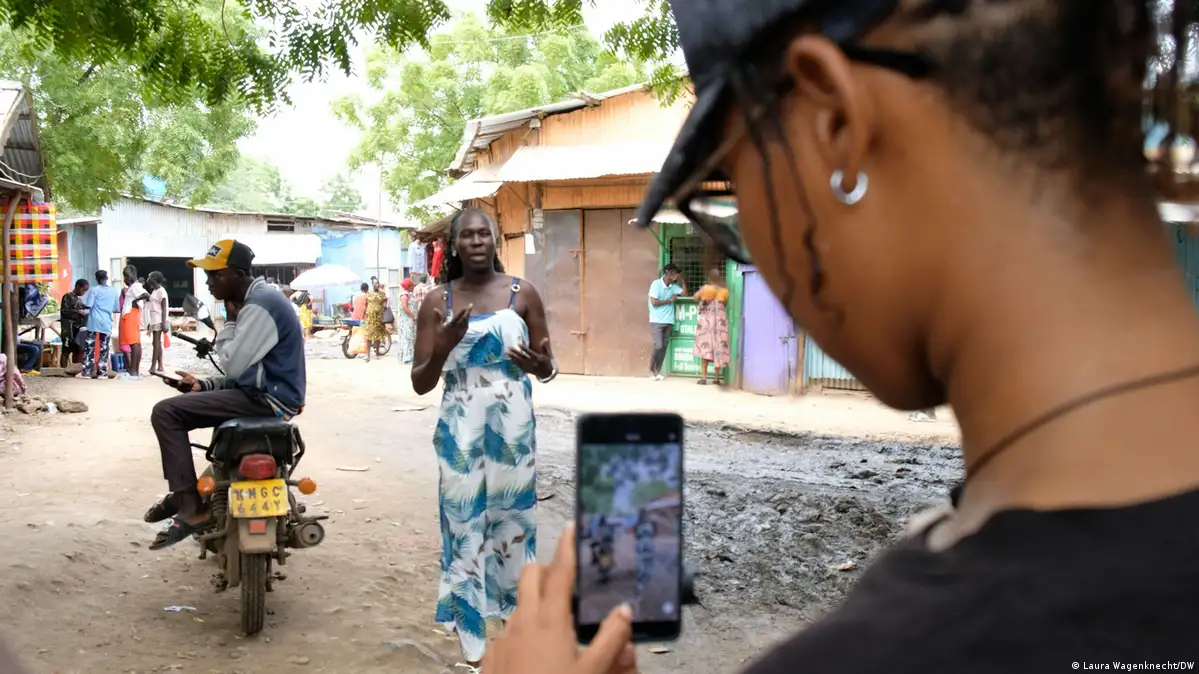
Since the USAID shutdown, Awat and his colleagues have witnessed how the cuts affect every aspect of life in Kakuma.
"It is saddening to see how medical staff has been reduced significantly," he said. "Try to imagine how people already considered vulnerable react when health services get worse. Women are no longer able to afford sanitary pads. This can lead to very desperate situations and exploitation."
"It is survival for the basic needs," Taphine Otieno adds. "With recent floods, houses were washed away, there is no money to build new ones, no roofs, and no food. Most people rely just on one meal a day, and even this is hard to come by. Children are no longer going to school; the organization has laid off most of their staff."
Otieno is worried about the months ahead, saying, "It is just a matter of time before we get an even more extreme rise of suicide cases than we already have, and where it becomes impossible to walk around because of safety issues."
Sikika remains a place of dialogue
With supply chains suddenly interrupted and resources becoming ever scarcer, Otieno and his colleagues feel that Sikika remains a provider of reliable information for many – and a source of trust.
"In this situation, communication is vital," he said. "If you do not communicate effectively, people will have their own interpretations and start making things up."
At the same time, people want to be informed about vital issues that affect them directly.
"When there is no food and you know this in advance," he said, "it is much better than people waiting for rations and then being told there is no food."
In response, Sikika has shared information between humanitarian organizations and the local refugee community, and effectively offered transparency and explanations on complex issues.

"One example," Otieno said, "are the protests against the Shirika plan [a 10-year socio-economic plan by the Kenyan government focused on the integration of refugees into local structures]. There were large scale demonstrations, people were angry. But when we started addressing the topic of integration, we realized that the emotions that had flared up suddenly eased down. It went from 'we don’t want anything to do with it' to 'let us discuss it.'"
Priority to community voices
The Sikika team’s work is shifting with the new realities on the ground. Since many staff members of humanitarian organizations had to leave their positions, Otieno and his team invite fewer official speakers.
"We realized that we need to give the community voices more priority over experts from international organizations," he said.
One example: To give people a space where they can gather and express their concerns, Sikika dedicated one of its recent episodesto the question "What happens when funding dries up?". According to Otieno, the work is vital to ensuring social cohesion.
"We are using our platform just for the community to share ideas, and to talk it out," he said, "I am a firm believer that when people get to speak out, anger goes down."
This is despite the fact that Sikika itself was affected by funding cuts. Not only the United States, but also other countries have reduced or reallocated their budgets for humanitarian aid and international development. But even though smaller budgets for Sikika meant substantially reducing the number of listener groups, community members acknowledged the important role of Sikika and decided to shoulder some of the burden. They voluntarily chose to work on the project with lower compensation, and 225 (from originally 290) listener groups have continued operating until today.
"We are part of the story"
Nevertheless, gathering personal stories inside Kakuma can be a challenging and sometimes even dangerous task for the community reporters. Since they transmit information from governments or aid organizations, they sometimes become the target of people’s anger. But even more often, they find themselves trying to help their protagonists out of a difficult situation before starting an interview, Otieno said.
"Being in Kakuma is one of these really tough things," he explained. "Sometimes I wonder: Is this real or am I dreaming? Someone would tell you they woke up and a family member had just attempted suicide. Or all the items in their house were stolen at night as they were sleeping. Or there was a fire and their house burned to the ground. You wonder what you can do to help them, and you know you cannot do much. Your task then is to console them and empathize with them."
This is even more difficult, he added, since the Sikika reporters themselves came to Kakuma as refugees, and share many of the hardships their protagonists describe.

"So, if there are no food rations, they [the community reporters] are also part of the story," he said. "If there are no health services, they are part of this community. When houses were washed away, people from the team could not come to the office for the rest of the week because they had no roof over their head."
Dealing with traumatic experiences together has become a daily routine.
"So most of the time we sit and talk and laugh it out and console each other as a family," he said. "And this extends beyond our team in the office, I also do the same with our listener groups out in the community."
Despite the difficult circumstances, Otieno, Awat and their colleagues keep reporting, aware that their work is a valuable resource for the entire community.
According to Otieno, people get worried of they do not receive news from Sikika: "If something happens in the community, we are the first ones to be asked: Is this real? What are your thoughts about this? Can you get some more information? I see direct impact of what we are doing."
It’s also supporting new community reporters like Awat that motivates Otieno personally.
"He has never studied journalism professionally," he said of his colleague, "but when I see him go to the field, record, come back, he is able to conduct an interview and write a story that will impact somebody’s life. That is the best part of journalism."
This sentiment is shared by Awat, who feels that he can really assist people in dealing with daily struggles.
"With every story that I do," he said, "with every person I talk to, there is a life out there that I am changing. If it helps with the betterment of their lives, if the information I give them helps them to make sense of their life, this really means the world to me. So, I wake up and I know that I will have to do this, again and again."
The audio platform "Sikika" provides reliable local information for over 303,000 people living in and around Kakuma refugee camp. FilmAid Kenya and DW Akademie established the platform in 2020. It is now a joint production between the Kenyan organization COME Initiative and DW Akademie to improve communication between refugees, the host community and humanitarian organizations that provide basic services like food support, health care and education. It is supported by Germany's Federal Ministry for Economic Cooperation and Development.