IMS: Student debate ahead of the 2025 Climate Conference

Bonn is hosting the UN's "June Climate Meetings," a conference to prepare for the COP30 in Brazil. Mariam Elbaz, International Media Students class of 2024, organized a panel discussion with fellow students and climate experts.
Article by Jéssica Moura
"Journalists are translators and a bridge between complex policy decision making and the audience". That was the main message from experts to the master's students.
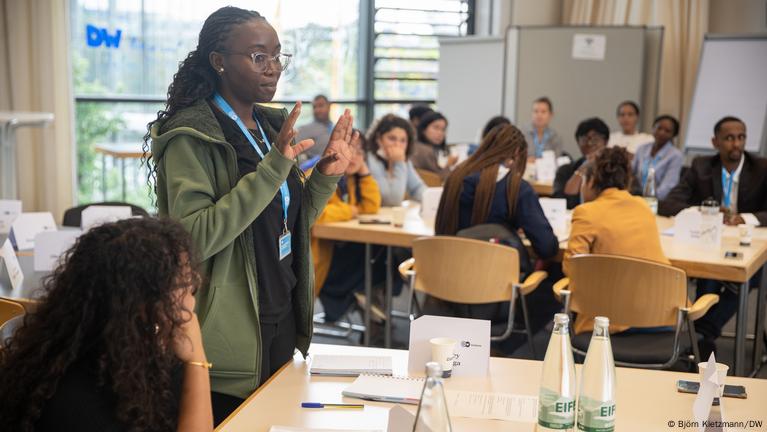
At the panel "The Road to the COP 30 - Understanding the climate negotiations from Bonn to Brazil" on June 16, 2025, a group of five environmental experts in policy making, science, civil society, and journalism highlighted key topics and gaps in climate change coverage.
Experts in global climate diplomacy
The students could collect relevant insights from players who are directly involved in global climate diplomacy: The invited experts all took part in the 62nd Subsidiary Bodies (SBs) meetings taking place from June 16 to 26 at the UN in Bonn.
"Our mission is to decode these negotiations so that we can understand them and communicate them with confidence, nuance, and also impact," said Mariam Elbaz, IMS student and organizer of the panel discussion. To enhance this knowledge and produce quality content about the COP, the experts recommended the students research the conference-specific terms and dynamics, be informed about the negotiations, and track the interests of governments, the private sector, and vulnerable communities.
One of the panelists was Judith Alonso, a freelance environmental reporter who has attended climate conferences since 2016. She said it was “important to humanize the topics in the coverage. If you are only focusing on the political negotiations, you won´t communicate the right way, since it is not attractive to people. It must be connected to daily life, and one strategy is to apply constructive journalism tools."
"We have to keep questioning this process"
Despite the importance of multilateral talks to promote action on environmental issues, students questioned the panelists about the limitations of instruments like the COP and their effectiveness in hindering climate change.

"The UN does not have any power over these countries so that they follow the policies. Is there any focus on accountability in this discussion?", questioned student Ilman Ramadhanu from Indonesia. Nouran ElMarsafy, Program Manager for Climate and Energy at Friedrich Ebert Stiftung in Egypt, shared similar frustrations and emphasized that changes take a long time to be implemented. "That is why we have to keep questioning this process,"
Dina Sielbeck, Climate Policy Officer at "Zukunft – Umwelt – Gesellschaft", said that "the process can look frustrating because there is no immediate reaction, but I assure you there’s a lot of movement behind the scenes in the context of bilateral works."

Fabio Cresto Aleina, Senior Expert on Climate Adaptation at "Global Citizen", added that there are many reasons for countries not to meet the commitments made during the negotiations. "In this case, next time, they will be less credible." He also reminded the Group about the advances achieved with the Paris Agreement, which for the first time managed to reach a goal to limit the temperature increase by 1.5 degrees Celsius.
"We can have some hope. The system learns from its mistakes, and there is a way out," said Anna de las Heras Carles, Policy Officer at CREAF.
This year, the Climate Conference’s objective is to come to an agreement on how to measure and evaluate the impacts of climate adaptation. That is what journalists and media professionals should be aware of.

Student Mariam Elbaz from Egypt organized the panel discussion. About her ambition to work as a science and climate journalist, she said: "I want to inspire greater public understanding and appreciation for the natural world and scientific discovery in Egypt."

Student Kalid Muktar moderated the session.

Article by Jéssica Moura, International Media Studies class of 2024.