Media development challenges in the Asia-Pacific region

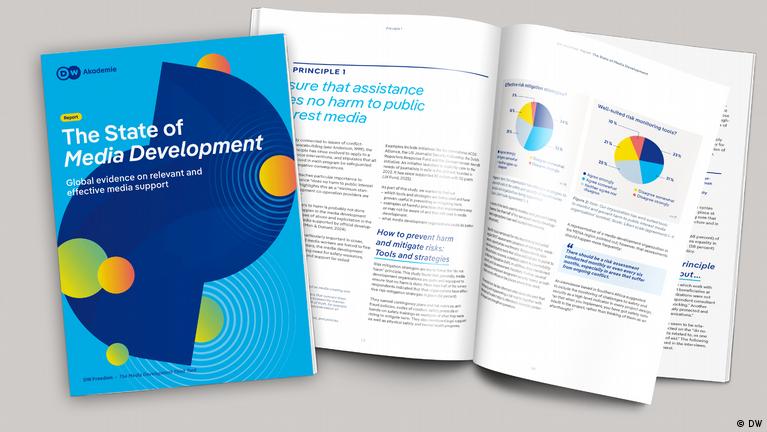
You will find the full report below.
International assistance has long been recognized as a crucial pillar supporting public interest media across the Asia-Pacific region. From empowering exiled journalists, to sustaining watchdog journalism in fragile democracies and conflict zones, donor aid often serves as the lifeline.
However, recent research led by DW Akademie, based on the OECD's six principles for effective media support and covering countries from Afghanistan to the Philippines reveals that donor aid is sometimes fragmented, poorly coordinated, and even unintentionally harmful.
A snapshot of progress: The six OECD principles across Asia
Principle 1: Do no harm to public interest media (minimally fulfilled)
Principle 2: Increase financial and other assistance (not fulfilled at all)
Principle 3: Take a whole-of-system perspective (partially fulfilled)
Principle 4: Local leadership and ownership (partially fulfilled)
Principle 5: Improve coordination (partially fulfilled)
- Principle 6: Invest in knowledge, research and learning (minimally fulfilled)
Principle 1: Ensure assistance does no harm
The assessment reveals that in politically restrictive environments across much of the Asia/ Pacific region, international assistance has unintentionally put media development actors at risk of legal harassment, reputational harm, surveillance, and threats to their safety. For instance, a media development organization in Mongolia working with US donors faced accusations of leaking national secrets. Similarly, in India draconian foreign funding laws (such as the Foreign Contribution Regulation Act or FCRA) indirectly discourage media development actors. In Kazakhstan, a media development organization representative informed that they were confronted with politically motivated tax penalties and threats of a shutdown due to their association with international funders.
Furthermore, donor logos and content oversight requirements — while designed for transparency and accountability — sometimes backfire by fueling accusations of foreign propaganda. This was mentioned by respondents from Myanmar, Nepal and Pakistan.
Despite these challenges, positive examples exist. In Mongolia, a media development organization adopted clear ethical funding policies refusing money from sources like tobacco companies to maintain editorial integrity. In Kazakhstan, a donor stepped in to cover politically motivated fines against an independent media outlet preventing its closure.
Recommendations
An important measure would be to integrate "do no harm" protocols into grant agreements avoiding visible donor branding in politically sensitive contexts and promoting ethical funding practices with mutual accountability between donors and local media to enhance safety, trust, and impact.
Principle 2: Increase financial and other forms of support

Chronic underfunding is a pervasive challenge for public interest media and media development organizations across Asia. Most media development organizations subsist on short-term project grants that barely cover operational costs, forcing them into precarious financial positions that increase vulnerability to burnout and eventual closure.
Donors typically prioritize project-based funding tied to narrowly defined deliverables leaving little room for core expenses like salaries, rent, or capacity building. Furthermore, much of the funding flows into urban and dominant-language media, sidelining rural, minority-language, and hyper-local outlets that serve marginalized communities.
This fragmentation extends to exile media which are additionally confronted by legal and financial barriers in accessing aid. Many donors also treat the media primarily as an instrument to advance other development goals rather than as a sector warranting direct, sustained investment. This mindset hampers funding for policy advocacy, legal reform, and organizational sustainability.
A good practice in financial sustainability comes from the Asian Media Information and Communication Centre (AMIC) which serves as a bright spot by generating 80–85% of its revenue internally through membership fees, conferences, and capacity building programs.
Recommendations
Donors are called upon to shift their support to long-term, core funding, strengthening local revenue generation, and prioritizing marginalized, women-led, and exile media to ensure the sustainability of public interest media in Asia.
Principle 3: Take a holistic approach to the information environment

Media ecosystems in Asia-Pacific are diverse and interconnected yet donor programs often remain fragmented and urban-centric. Research shows donor assessments typically focus on capital cities, neglecting community radio, rural outlets, and minority-language media. As a Nepali expert noted, "You can't understand the media system if you only talk to NGOs in the capital."
Critical issues like algorithmic bias, AI-generated misinformation, and digital surveillance remain underexplored. Donor strategies seldom integrate regulation, digital literacy, or policy reform, despite their growing importance for sustainable media development.
In Nepal, India, and Afghanistan, locally led diagnostics are informing programming while in Pakistan and Myanmar, inclusive strategies now support women-led, minority, and exile media — marking notable good practices.
Recommendations
Comprehensive ecosystem diagnostics that capture diverse political, social, and technological contexts should be funded. They should integrate media literacy, digital regulation, and policy reform into media support and address digital risks like algorithmic bias and surveillance through holistic strategies.
Principle 4: Strengthen local leadership and ownership

In many countries in the Asia-Pacific region, international donors tend to control strategy and funding sidelining local media groups and treating them as subcontractors. Strict eligibility criteria, language barriers, and complex procedures exclude grassroots organizations. Local actors in Nepal, Myanmar, Mongolia, and Kazakhstan argue that most funding goes to international NGOs, despite local groups being better suited for impact. A South Asian media leader emphasized the need to "listen to the people they are trying to help."
The research brings in positive examples includingAMU TV run by Afghan journalists in exile, Nepal's community radio networks with participatory governance, and diaspora and minority-led media houses in Myanmar shaping editorial agendas rooted in their communities.
Recommendation
Direct funding to local and diaspora-led media should be prioritized using participatory design in funding decisions and simplifying and supporting grant processes to increase accessibility for grassroots organizations.
Principle 5: Improve coordination among donors and development actors
The research found that coordination across donors tends to be reactive, crisis-driven, and fragmented. Emergency situations—such as the fall of Kabulor Myanmar's military crackdown — catalyze rapid collaboration, but these are exceptions rather than the norm. Most of the time, overlapping funding cycles, inconsistent messaging, and duplicated efforts among media development organizations is prevalent.
Poor data sharing, weak joint planning, and complex administrative requirements are reported by the key informants. It is important to note that coordination mechanisms rarely include local actors or emerging media such as digital creators and youth networks.
Recommendations
Country-level coordination groups should be created for donors, promoting information sharing, and aligning media support with broader governance and human rights efforts to enhance collaboration and impact.
Principle 6: Invest in learning and innovation through research
Investment in learning and research holds significant promise but remains chronically underfunded. While local actors are deeply committed to peer-learning, safety research, and analyzing digital threats, donor funding for such activities is inconsistent and insufficient. If there are research efforts, they tend to be informal, short-term, and heavily reliant on donor funding.
Organizations in Afghanistan, Myanmar, Nepal and other countries demonstrate strong commitments to monitoring, evaluation, and adaptive learning despite challenging conditions. South-South knowledge exchange models, such as AMIC's in the Philippines embed evaluation into programming and stimulate critical conversations on media issues.
Recommendations
Media development professionals across Asia call for more evidence-based, locally produced knowledge to guide programming and policy. They also emphasize journalism education to integrate emerging challenges like AI, misinformation, and changing audience behavior.

Umesh Pokharel is the Asia Research Consultant for DW Akademie's State of Media Development 2025 research project. He previously served as the South Asia Coordinator for the International Federation of Journalists and has held diverse roles across media and development organizations throughout his career.