AI: Polarization, trust and social sustainability

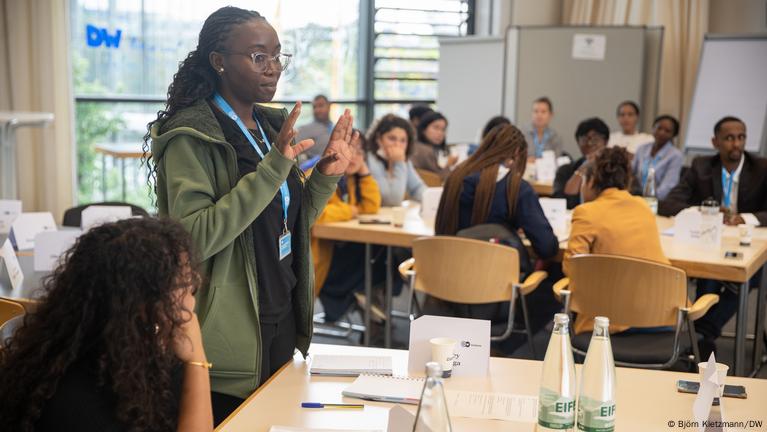
On December 4, 2025 four guest speakers shared and discussed insights from their current research on AI in the Media with international academic partners and alumni at the biannual IMS Digital Media Debate. The researchers and media and communication experts discussed the fundamental understanding of AI as a new way of communicating, strategies to construct trust and counter the polarizing effects of AI, and finally if the use of AI is socially sustainbale, particularly in the field of media education. Among others questions, they debated the role global power imbalances, political systems and journalists play with the participants.
For instance, Dr. Soumaya Berjeb asked, "To what extent might the geopolitical and economic race undermine the ability of smaller or less influential states to resist political and informational polarization?"
"Beyond our role as content curators, what responsibilities do journalists have in helping reduce bias within these AI systems?", IMS alumna Carolina Judith Medina Guzmán reflected in conclusion.
You can read the researchers' main arguments in their abstracts below:
Theorizing Communication in the Context of AI
The talk emphasizes the implications that artificial intelligence may have on the development of communication theory. It highlights the history of the development of artificial intelligence, the problems in defining it conceptually, and the challenges it presents in understanding contemporary phenomena of technologically mediated communication. It proposes an analytical look at artificial intelligence, recovering one of its origins linked to computer science and the original proposal of the Dortmund Summer.
From there, it reflects on the notion of “worldview” and its possible implications for understanding and theorizing communication. Finally, cybersemiotics is presented as a conceptual alternative for thinking about communication today, a transdisciplinary theory of communication, meaning, and information.
Using AI for Non-Polarizing Communication
The rapid rise of Artificial Intelligence (AI) is reshaping digital communication, offering new possibilities while also intensifying polarization that threatens the goals of peace, justice, and strong institutions under Social Development Goal (SDG) 16. AI systems can deepen societal divides by reinforcing echo chambers, accelerating misinformation, and weakening trust in democratic processes.
The presentation delivered for the IMS Digital Media Debate 2025 shifts from diagnosing the problem to outlining the following seven key strategies for fostering non-polarizing communication in the AI era:
- Algorithmic Transparency and Ethical AI Design,
- Strategic Content Removal,
- Dialogue-Focused Moderation and Deliberative Digital Architecture,
- Communication and Digital Literacy for Societal Resilience,
- Cross-Sector Collaboration and Shared Governance,
- Strategic Framing and Narrative Sensitivity,
- Countering Disinformation and the Weaponization of Truth.
These strategies provide a framework for ensuring that AI-enabled communication strengthens social cohesion and democratic resilience, helping advance SDG 16 rather than undermine it.
Upcoming Publication:
Genilo, J. W., & Intaratat, K. (2026). The need for non-polarizing communication to attain Sustainable Development Goal 16. In M. J. Yusha’u (Ed.). Communicating Sustainable Development Goals in the Age of Artificial Intelligence. Palgrave Macmillan.
How Trust in AI Is Made: Semantics, Strategies, and Societal Implications
Trust in Artificial Intelligence(AI) is increasingly framed as a societal and political necessity. Originally, however, trust is a psychological concept referring to interpersonal expectations (Glikson & Woolley, 2020; Luhmann, 1968). In the context of AI, the term undergoes a semantic shift: Trust is no longer located between acting subjects but transferred to technical systems and strategically used within media and communication contexts (Gür-Şeker expected 2026; Tschopp, Ruef, & Monett, 2022).
The talk in the context of the IMS Digital Media Debate 2025 examines how trust in AI is constructed in public discourse between 2018 and 2025, focusing primarily on German media coverage and selectively drawing on English-language press releases issued by technology companies (Gür-Şeker, 2021, expected 2026). The analysis centers on semantic framings and discursive strategies through which trust is strategically used to (de)legitimize technological developments and to shape public perceptions. From a discourse-linguistic and media-analytical perspective, the talk reflects on how trust is communicated and discursively negotiated in the context of AI.
Is AI Socially Sustainable? Promises and Perils for Media and Democracy
We achieve social sustainability if our vital social institutions and norms can last into the future without serious disruption or harm. AI, when integrated into journalism, education, and democracy, may both support and undermine social sustainability.
In terms of education, AI allows much broader access to education than traditional methods, and promises to create personalized, tireless tutors for almost any subject. At the same time, AI also abets academic cheating and may lead to deskilling when traditional academic tasks are offloaded. In terms of democracy, AI can easily create deepfakes and other manipulation but can also promote political education and reasoned deliberation.
AI may also increase access to journalistic media and audiences for oppressed or under-resourced people and communities. But it threatens to centralize journalistic processes in a few frontier AI firms (and similarly, to centralize manipulable or manipulative newsfeed algorithms) and offers the temptation of generating deepfakes instead of producing genuine footage.
In the age of AI, journalists’ social roles may change. I argue that one’s brand (personal or corporate) will start to matter more, because it will become more difficult to tell from content itself whether to trust it. Because of the firehose of AI slop and misinformation, journalists will play a greater role as curators of existing content.
In turn, journalism education should cover AI tools; core investigative competencies such as personal interviewing and developing sources; and training journalists to go beyond presenting the truth to audience, to the goal of getting audiences to care about the truth.