Community radio and podcasting: Local goes global

Community radio has long been a vibrant center of communication for neighborhoods, towns and rural regions across the world. Often in places where mainstream media barely reaches or doesn’t seem to care to. Community radio has been the reliable old friend — local, scrappy, sometimes rough around the edges and stubbornly determined to give people a place on the airwaves. These days, thanks to the rise of podcasting, these voices aren’t just limited to the strength of their inexpensive transmitters — these stories are traveling the world.
In many places, if you wanted to hear a story about your neighborhood, about you and your neighbors’ concerns and in your own language, community radio was often the only place you could find it. Whether it was a radio station run by Indigenous activists in the Andes, rural farmers in Myanmar or a women-led program in rural India, these broadcasters had something mainstream stations didn’t: authenticity, access and independence.
But traditional radio has limits – the signal only reaches so far. You need a radio receiver. You need power. You need a generator when the power goes out. And you need to be listening at the right time. Then podcasting came onto the scene. It was an on-demand, global, mobile-friendly format that community radio never knew it needed — until it exploded.
Community media: Supercharged
Podcasting didn’t start in community media, but community media has embraced it in a big way. It’s like giving your trusty old bike a rocket engine. Now, a show recorded in a small rural station in Oaxaca, Mexico, can be heard in Berlin, New York or Jakarta.
Instead of having to tune in at a specific time on the radio, listeners could access stories whenever and wherever they wanted. For communities with poor infrastructure or limited electricity, that’s a big deal. A podcast file can be shared on a phone, downloaded via mobile internet or even passed around on memory cards or USB drives.
Ernesto Lamas, a longtime community media activist from Argentina, calls this the “social podcast.” He’s been at the forefront of connecting community radio with podcasting, helping broadcasters see podcasting not as something corporate or slick, but as a natural extension of what they’ve always done: tell real stories from real people. He’s been leading the charge in his native Argentina (see featured interview in this issue), but his efforts are part of a global tendency to take advantage of podcasting to create local stories with a global reach.

An example: Radio ORANGE 94.0, established in 1998, is Vienna, Austria's only community radio station. A non-commercial, politically independent platform, it has 200 shows in 17 languages and reflects the city’s multicultural fabric. When podcasting came around, Radio ORANGE integrated the new format to extend its reach and accessibility, showcasing the city’s rich cultural offerings and creativity to a global audience.
South Africa's Bush Radio was the first community radio station on the continent. Its enthusiastic adoption of podcasting aligns with its mission to ensure community participation in media production and to address issues important to their audience. At the same time, the on-demand aspect addresses the consumption habits of listeners, especially younger demographics who prefer digital media. And it ties into their goals of amplifying underrepresented voices, fostering social responsibility and critical thinking – far beyond Cape Town.
One reason podcasting fits so well with community media is its flexibility. You don’t need an expensive studio. You don’t need to go live. You can record in pieces, involve different voices in different locations and remix them later. And because it’s digital, content is much easier to archive, making podcasting a valuable tool for preserving memory, especially in communities that have been left out of official histories.
Take Radio Ambulante, for example. Though not a community station per se, it’s brought long-form narrative storytelling to Spanish-speaking audiences all over the Americas. Its episodes often feature voices from the margins: Indigenous people, LGBTQ communities, migrants, the working class. It's professional and polished, yes — but the spirit of community storytelling runs deep in its DNA.
In fact, to boost audience engagement, Radio Ambulante has initiated Listening Clubs, where listeners from a community gather to discuss episodes and their relevance to the local context. Launched in 2019, these clubs started in cities like New York, Mexico City, Medellín, San José and Quito, and have since expanded to Bogotá, Lima, Guatemala City and Madrid. This initiative fosters community dialogue and strengthens the connection between the podcast and its listeners
In Uganda, community radio stations like Radio Apac have used podcasts to continue reaching audiences during times when live broadcasting wasn’t possible due to technical or financial constraints. By producing and distributing content via podcasts, they’ve kept their educational and health programs going — even when the airwaves went silent.
Collaborative approach
There’s also a shift in mindset. Podcasting encourages collaboration. Community members can suggest topics, provide interviews and even help edit. And because it’s not tied to a rigid broadcast schedule, there’s more room for creativity, experimentation and reflection.
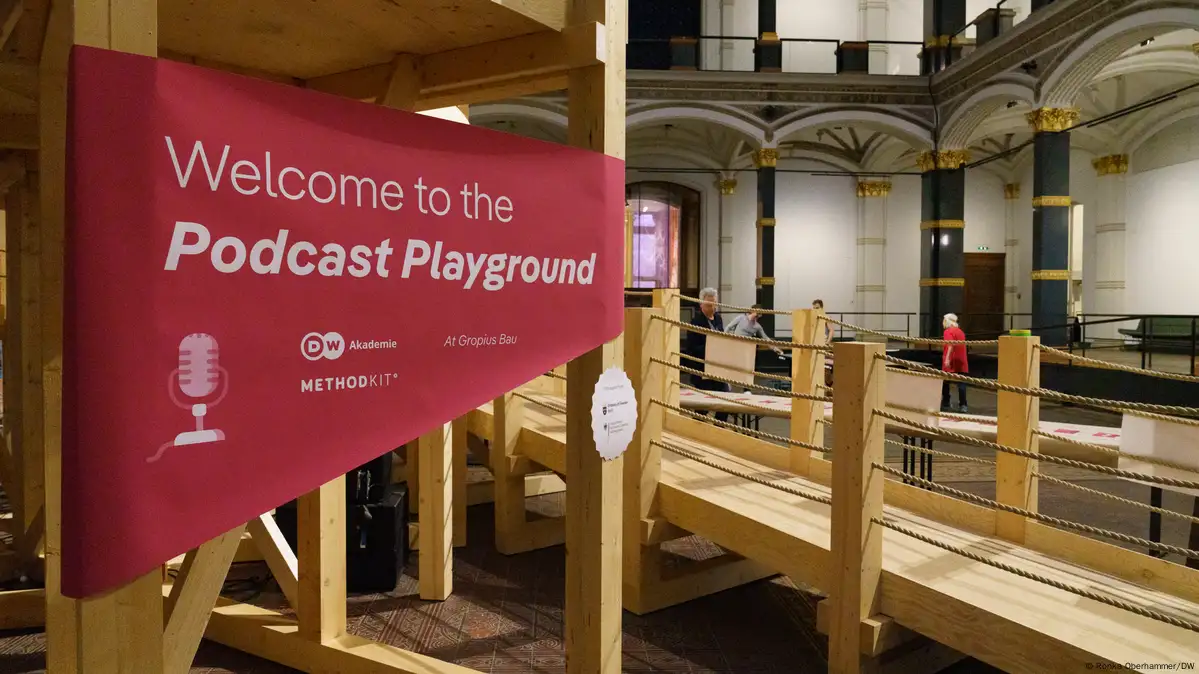
That's why many producers now see podcasting not just as a distribution method, but as a way to build networks. It creates space for intergenerational storytelling, for Indigenous language revival and cross-border solidarity – all goals that help Ernesto Lamas bring community stations from around Latin America together and resulted in his book “Poscat”. Podcasting can bridge rural and urban divides, and let people connect over shared experiences even if they’re thousands of kilometers apart.
Community radio taught us that media should be participatory, not passive. Podcasting is letting that idea travel far and wide. Whether it’s a teenage girl recording a climate story on her phone in Laos, or an elder in a Mapuche community sharing oral history in Chile, the tools are now in more hands than ever.
Sure, there are still challenges. Internet access isn’t universal. Production takes time and effort. And monetization is tricky, especially for non-commercial outlets.
What’s exciting is that the fusion of community radio and podcasting is building a new kind of media ecosystem — one where power isn’t concentrated at the top, but shared across a wide and growing network of creators. Creators who are telling stories that are bold, funny, heartbreaking and chock-full of the rich diversity of life.
