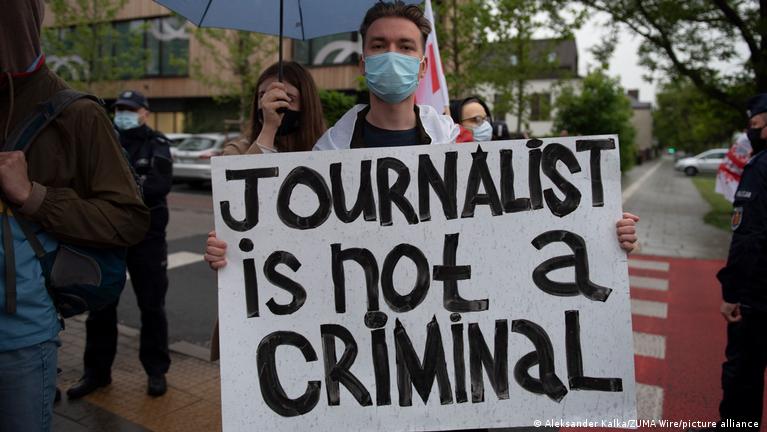
Journalists in Belarus consider exile so as to continue work

For more than the three decades of Alexander Lukaschenko's rule in Belarus, most opposition members and all independent media workers have either fled abroad or are imprisoned. The election results - in his favor with 87.6 per cent of the votes and confirmed by the official election committee - in January ushered in Lukashenko's seventh term in power.
Nevertheless, a Chatham House study conducted between December and January shows that just 36 per cent of Belarusians had expressed willingness to go to the polls.
The Committee to Protect Journalists (CPJ) ranks Belarus fourth out of the top 10 countries that imprison journalists. On December 1, 2024, CPJ also reported that 31 journalists were in prison in Belarus among the 361 journalists in jail worldwide.
Despite these challenges, exiled journalists continue to investigate and report on critical issues happening in their home countries. However, their work is fraught with danger; they face threats to their safety and often must conceal their identities when reporting.
The Press Club Belarus, a DW Akademie partner in the Space for Freedom program, focuses on assisting émigré media, despite – or perhaps because – most of its managers have been detained at some point in the past decade while advocating for free speech, human rights, and quality media. Or else, they fled the country after the 2020 elections and subsequent protests in Belarus. Since early 2021, Press Club Belarus has been operating out of Warsaw, Poland, with the same mission, in addition to supporting other exiled journalists by fostering a sense of community and belonging.
PCB: Fostering a sense of belonging among exiled journalists
"Our entire production is blocked in Belarus, and one of our major programs, Media IQ, is labelled as 'extremist' in Belarus," said Nadezhda Belokhvostik, Space for Freedom program manager at Press Club Belarus. "Unfortunately, at least one person from our production team is now serving a sentence in Belarus."
The regime imposes labels such as 'extremist' or 'foreign agent' to 'cleanse' the media ecosystem, making it impossible for independent media to operate in the country. As a result, very few independent media outlets have remained in Belarus since 2020.

Press Club Belarus has been working with DW Akademie since 2022 as part of the Hannah Arendt Initiative. Over four rounds of the program, more than 80 journalists have benefited from it.
"We provide support in various areas, starting with legal assistance—such as how to prepare documents and work with lawyers—to educational support, workshops, training on crowdfunding, SEO, content monetization, and, of course, professional support," Nadezhda added.
The Story of Elvira Korolyova
Elvira Korolyova is among the journalists who has participated in Space for Freedom activities. Her story of exile began in 2020, when she was working as a freelance journalist in Belarus.
"I was receiving emails from colleagues saying, ‘They came after me, they raided our office.' I knew that sooner or later, they would come for me, too. At some point, I just took my kids and fled to Poland," Korolyova said.
After settling into exile, she became an advocate for disabled children. She created a digital support network—a community chat connecting children with disabilities and their families in Belarus and Poland, which grew to more than 800 participants. A platform for connecting families seeking resources, the chat group offers information on accessing affordable medication, and it provides emotional and logistical support for those wanting to relocate.
The community chat was Korolyova's means to keep up communication with an audience in Belarus, until one day, when the chat was labeled as extremist. This put the chat's members in Belarus at risk of prosecution, forcing Korolyova to warn them to stop participating on the platform.
"It’s like we have to tell them, 'Sorry, you have to forget us, but it's for your own safety,'" she said.
She later joined Press Club Belarus, where she expanded her activism into journalism and art by producing videos on young Belarusian artists with disabilities.
"I came to (the) Press Club Belarus to learn how to make videos myself," she said, "as now it's very complicated to hire a cinematographer who will record a video for you."
Her TikTok shortsfocus on a disabled Belarusian artist living in Cracow. The videos have gained around 60,000 views and have led to donated essential digital devices and equipment for the teenager.
For Korolyova, exile has blurred the boundaries between journalism and activism.
"After exile, the thin line between journalism and activism blends, and it's sometimes hard to distinguish between the two," she said. "I think they work best in combination for me. I know how to approach the issue, I have distinguished for myself the area I want to focus on, and I want to bring change."
Audience engagement amid financial constraints and censorship
Even in exile, the role of independent media remains critical in conveying trustworthy and credible information inside the country. However, Belarusian authorities systematically block independent media websites, branding them 'extremist,' and criminalizing news consumption.
"Most independent media were forced to flee and work from exile," said Belokhvostik, of the Press Club Belarus. "Our readers and viewers remain in Belarus, but consuming independent content is now criminalized. Our readers are the bravest Belarusians."
Press Club Belarus: The role of exiled media in shaping a perception of reality in Belarus
At the same time, she noted, "Exiled media are officially denied existence, yet even government representatives sometimes cite them."
While exiled media outlets depend on grants, global funding uncertainty has put their operations at risk.
Additionally, following the US presidential directive to suspend foreign assistance via the U.S. State Department and USAID, dozens of independent media outlets in more than 30 countries, including Belarusian media in exile, have been severely affected.
"Back in Belarus, I had the privilege to choose what topic to focus on, what to cover," said Korolyova. "Here, we cannot allow ourselves that as we feel we have to pursue any topic which can sustain us financially for some time. Projects like Space for Freedom, support us to take out the topics we kept in our pocket for so long and put all our efforts and capacity into working on them."
With financial insecurity growing, many exiled journalists are reconsidering their professional paths. Some are leaving journalism altogether in pursuit of stable income.
"Our community is made up of true professionals, and it was heartbreaking to realize that many of them found themselves in such difficult situations that they were ready to leave the profession," said Belokhvostik. "Thanks to this program, some managed to stay."
Author: Diana Shahbazyan
The Hannah Arendt Initiativeis a program of the German Federal Government for the protection of media professionals in crisis and conflict areas. Space for Freedom is a DW Akademie project within the initiative and is funded by the GermanFederal Foreign Office. It focuses on journalists from Afghanistan, Russia, Belarus and Central America.