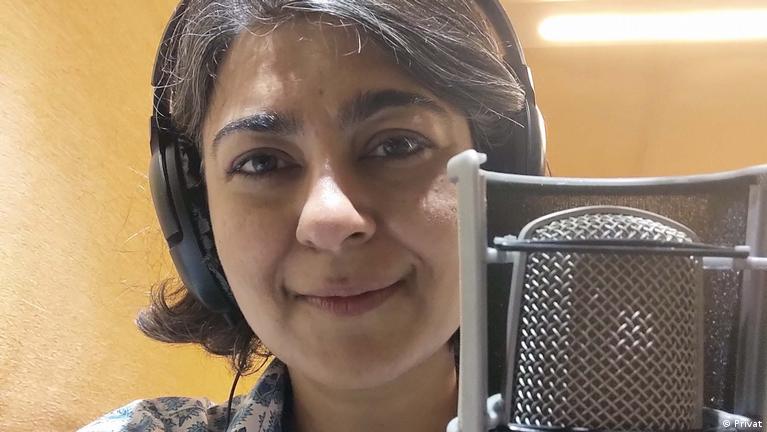
Ernesto Lamas: Using podcasting to promote community voices

Ernesto Lamas, Argentine community radio pioneer and co-founder of FM La Tribu, promotes podcasting as a powerful tool for community voices, human rights, and the preservation of untold stories across Latin America.
Argentine Ernesto Lamas has devoted decades of his life working to make communications more democratic. He's driven by giving a voice to communities often overlooked by the traditional or commercial media. The 57-year-old communicator and educator is renowned for his contributions to community radio in his native Argentina and across Latin America.
He's currently a professor of communication sciences at the University of Buenos Aires and an independent producer of audio and podcasts. In 1989, he co-founded FM La Tribu, a pioneering community radio station in Argentina. It’s still very active and has evolved into a multifaceted cultural and communication collective that serves as a platform for underrepresented voices and for alternative and youth culture in the Argentine capital.
Lamas' support for community radio also included his role as President (1997-2000) and Regional Coordinator (2003-2011) of the World Association of Community Radio Broadcasters for Latin America and the Caribbean (AMARC ALC).
A man of many hats, Lamas also works on communication policies, andcoordinates the Community Media area at the think tank OBSERVACOM, whose mission includes the safeguarding of communication rights. He's also been involved in documentary filmmaking with the group "Cine Ojo."
In 2023, he added “author” to his CV with the publication of the book "Poscat. El podcast después del podcast" (Poscat: The podcast after the podcast) with Gastón Montells. In it, they explore the possibilities around new technologies and community media.
DW Akademie: Let's start with your recent book, "Poscat: El podcast depués del podcast." What's it about? And do tell us what a "poscat" is!
Ernesto Lamas: (Laughs) The book is a product of research we did during the COVID pandemic. From our homes, we developed a training series aimed especially at community radio stations, highlighting the importance of producing in the podcast format—which was really booming. These workshops brought together community radio stations from across Latin America – from Mexico to Chile. Even though podcasting had existed since 2004, it now required more professionalization, and we needed to recognize its potential.
During those exchanges, participants often called the format by slightly different names—some said “postcast,” others “poscat,” and so on. So decided to name it Poscat to reflect that playful approach. The book looks at what came out of those exchanges we had and now i'’s used in a seminar at a university.
The part of the title "The podcast after the podcast" is like saying: what comes next?
Yes. It comes from research we did some years ago when the internet became more established in Latin America. Community radios did not see the internet as an aggression or a threat—they saw it as an opportunity to enhance and expand the work they already did.
Then, we did a study called "La radio después de la radio" (Radio After Radio) to look at how technologies like cell phones, blogs, wikis, streaming and social media—and podcasting—allowed community radios to broaden their reach. Naming the book "Poscat" was a way to continue that investigation and to suggest there are many ways to do podcasts, especially through the lens of community media.
Something you’ve mentioned before is the "social podcast." Can you tell us what you mean by that and how it relates to the community radio approach?
It's our way of summarizing what we’re inviting community radios to do—to adopt the podcast format as their own. Not to see it as something only used by corporations, big political parties or journalists. But rather something community radios can use to expand their reach.
With podcasts, they can tell stories, look at their surroundings—especially in ways we encourage: not following mainstream media agendas, but instead highlighting local stories that deal with citizenship, human rights, diverse culture, minority rights and public voices from groups that usually don’t have access to the public sphere.
Thanks to technology, podcasting lets community radio extend its frontiers and its coverage. We call it a social podcast because it has the potential to maintain its core mission.
You’ve emphasized "collaborative production," which sounds like it falls squarely within the community media ethos. Do you mean where several people or groups work together to produce something?
Yes, it simply means democratization. I’m not saying that everyone always participates equally or ideally. There are always production centers, like a community radio station or a content producer that leads. But there’s an invitation to the wider community: to suggest topics, raise concerns, contribute different perspectives or help shape future episodes. It’s collaborative in the sense that when you listen to the first episodes, there’s input that leads to more episodes or deeper investigation.
And I want to stress this—community media aims to be very professional. Sometimes "community" gets equated with "amateur," "poorly made," or "half-done." But my experience—as an activist and a trainer—is that there’s a strong push to be professional. We want to offer great content, conduct deep investigations, entertain and meet the audience’s needs. Otherwise, we wouldn’t even bother listening to ourselves!
What do you think of the state of podcasting in Latin America? Are you satisfied with its development?
I don’t know if I can give a conclusive answer about satisfaction or dissatisfaction. What I do see is a moment of explosion for podcasts, right? Many people are producing interesting and attractive content from different sectors. The format has become more accessible. On the commercial side, and even among individuals, there’s a lot of experimentation and creativity. So if I had to balance it out, I’d say there’s been good movement among community actors who are actively trying to expand the radio and who are contributing a lot to the podcast format.
Back in 2004 or 2005, when podcasting first appeared, you had been very active in community radio for a while. Did you see this new format as an opportunity or maybe a threat?
A very good question. In our book, we say that for community radio people, podcasting wasn’t a threat—rather, it was an opportunity to expand. And not just technically, but in terms of relationships. People who may not have spoken before or been heard they could build something new. Of course, it took time, and maybe it was more informal. I remember we used to record reports, copy them on cassette tapes and then send them to community radios around Argentina by postal mail. There was no internet back then, but there was already this idea of sharing extended audio content. So podcasting, and its ability to spread content via the internet, was very much aligned with that tradition.
That's why I find it funny when people say radio died. It didn’t. It just changed. Radio always finds a way to multiply, through the internet and then through podcasting.
Are there examples of interesting or inspiring podcasts you’ve seen from local or Indigenous communities in Latin America?
Yes, I’ll give you one that I really care about. It’s called La Finca, and it was produced by a campesina radio station in Mendoza, in the Andes mountains. It’s a great example because it involves peasants, students and local activists. They started talking about an occupation in the region and then turned that into an investigation. Another one I can mention is produced by the Latin American network WACC—Camino hacia una vida plena (Path Toward a Full Life). It tells personal stories of migrants: women, children, migrant workers. It’s a very strong example. In this case, the podcast was created by a regional network in collaboration with local organizations.
Do you see podcasting as a tool for memory or archiving? Especially for things that might not be present in mainstream media?
Yes, exactly. That’s one of the things we promote in the book—to think of podcasting as an opportunity to preserve stories, not just of the community, but sometimes even of the media outlets themselves, who struggle to tell their own histories. Podcasting can be a kind of “sound archive.” And that’s really powerful, especially for reaching places where access to traditional media is limited. The Internet doesn’t always reach everyone, but sometimes a podcast can be shared on a memory card or phone. It’s easier to distribute and access, compared to radio, which needs a receiver, electricity and infrastructure. So even in rural places, a podcast can be a powerful way to share informative or personal stories.
Looking ahead, where do you see podcasting going? Especially in Latin America?
I think the future of podcasting will have to do with diversity. Especially here in Argentina, where we have people who are children or grandchildren of migrants—many of whom don’t know their own history. For someone outside Argentina, it might seem like we’re all the same—white or European-looking—but that’s not the case. There’s a huge diversity of experiences, music and roots. Podcasting helps make that visible, protect it and amplify it.
So I imagine the future not as one where we unify or homogenize, but one where we multiply and respect diversity. And that means recognizing all kinds of voices—not just professional announcers or those with degrees, but all the ways people speak and express themselves. We’re built from words, and freedom of expression is a right of the people. Podcasting has the potential to democratize communication.
Thirty-five years ago, when we founded FM La Tribu, we needed an FM frequency. Today, I wouldn’t think of starting an FM radio station. I’d start by producing digital content—audio, video—something mobile, powerful and able to reach specific audiences. That’s what I see as the future of podcasting from a social perspective: expanding who gets to produce, what stories get told, and how we share them. Because there are infinite stories—and a lot of them still need to be told.
The interview was edited for length and clarity.