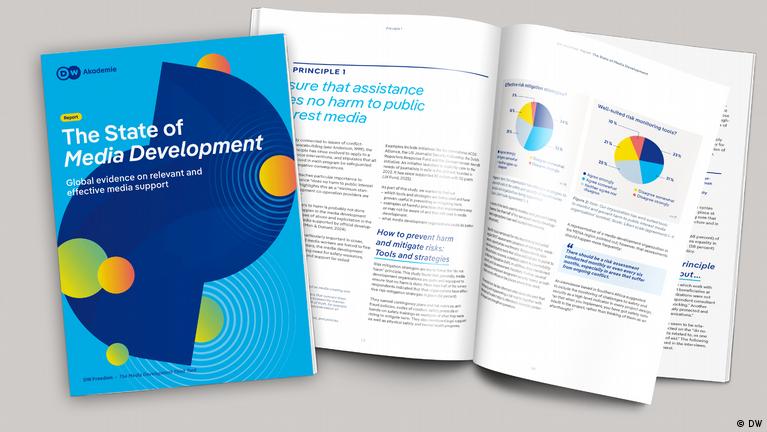
The State of Media Development Report 2026

"We are no longer living in a stable rules-based international order", writes Martin Scott, Professor of Media and Global Development at East Anglia University (UK), in his accompanying article to DW Akademie’s State of Media Development Report 2026. With resources drying up, not least because the U.S. administration has pulled the plug on international development funding, a rise in authoritarianism and another large-scale tech reset looming with AI, media development organizations are struggling to meet the challenges.
According to data collected in 2026 for the report, only 11 percent of organizations surveyed have sufficient funding to meaningfully support public interest media and the information environment. Many governments are imposing legal barriers for support and putting media under pressure, resulting in a high demand for digital safety measures. Media development organizations have been able to adapt to this need, with over 60 percent offering digital security support. One field that unsettles both media outlets and media developers is AI. While capacity building is needed, organizations also stress the need to engage with Big Tech to ensure fair use of their reliable public interest content.
But there are signs of hope. 71 percent of the organizations surveyed are convinced that they are successfully adapting to the shifting landscape. Some philanthropic foundations are stepping in to fill some of the funding gaps and dynamic initiatives like M20 and CTRL+J are driven strongly by Global Majority actors. The sector has understood that hyper-competition will not save it. Rather, closer co-operation seems to be the key. "If we adopt a short-term competition approach, I think we will all lose", said one respondent. "So, we all need to reinvent ourselves. And make sure that the priority is the best way to defend, protect and promote the values that got us into this sector."
Insights based on 76 interviews and a sector-wide survey
77 organizations (16 international, 21 regional and 40 national/ local organizations) took part in a global survey. Additionally, key informant interviews were conducted with 76 individuals who work in the sector. Interviewees included representatives of organizations based in countries across the globe as well as non-affiliated consultants with a good overview of the sector. Further details on the methodology can be found in the report's annex. The empirical base was laid between November 2025 and February 2026.
The lead researchers were Ines Drefs, Rose Kimani and Dennis Reineck. The majority of interviews were conducted by regional researchers MJ Daoud, Bianca De Toni, Senakpon Gerard Guedegbe, Shafiq Ahmad Kamboh, Omar Meksassi, Waqas Naeem, Adnan Rehmat, Maryia Sadouskaya-Komlach, and María Soledad Segura. Regional reports (Africa, Asia, Eastern Europe, Latin America, MENA) will be published later in the year.