"AI will not solve the business model question"

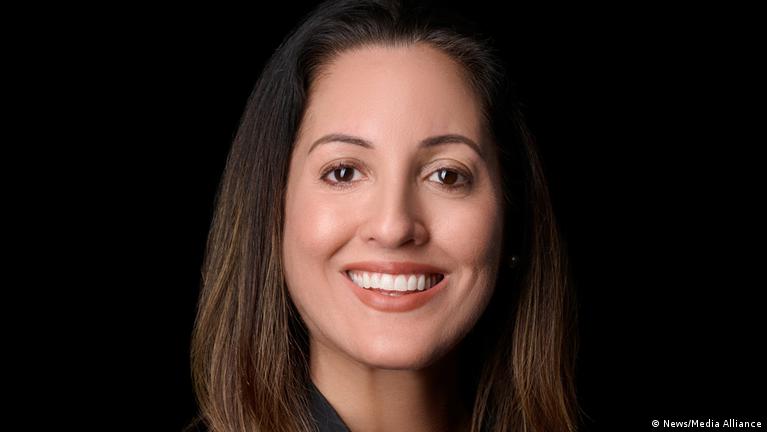
Courtney Radsch is the director of the Center for Journalism and Liberty in Washington which develops policy solutions to ensure that the news media is, as the center’s mission statement says, "fully independent and robustly funded in the 21st century’s digital economy." DW Freedom spoke with Radsch about how to counter the challenges AI poses to the business models of public interest media.
DW Freedom: Media development organizations and their partners have been working for years now on strengthening media viability. Still, public interest media are increasingly under economic pressure. Do we need to rethink the media development sector’s viability efforts?
Courtney Radsch: Part of the strategy we need to follow is a systems level approach to addressing the financial challenges for journalism. There is often this idea that we need to work on the business models of individual media organizations. However, these business models depend on the broader political and economic landscape they are embedded in. And so, in an economy where a handful of US tech giants control most of the business models online and information flows, there is a very limited set of business opportunities available. In our media ecosystems, public interest media outlets are dying because big tech takes up all the oxygen – they control access to advertising, audience, attention, and data.
Similar to social media, AI is yet another technology undermining public interest media’s business models. Are we better prepared this time?
Just like it happened with social media platforms, innovation and development in AI are mostly driven by the largest companies and countries. It is not AI the technology, it is the dominant AI corporations that are undermining media business models. Media ecosystems can be analyzed on different levels: Globally, on a country level, or even on the level of a city’s ecosystem. However, on all these levels, Big Tech is shaping the tech infrastructure that determines business opportunities for public interest media operating in a particular ecosystem. We are doing a disservice for the era we are in now by continuing to take a primarily country-based approach. We need a global approach to AI regulation because powers like the US and the EU have more leverage with these huge tech firms.
Has the media sector fully understood the implications of AI yet?
So far, the media sector is mainly discussing how to use AI in the newsroom, which will increase the sector’s dependency on Big Tech even further. There is very little debate on how to shape AI policy in a way that makes sense for public interest media.
Most newsrooms are small and therefore it is unrealistic to expect smaller media outlets to handle advocacy, research, and policymaking. We need coalitions across sectors; partnerships with creative industries, small businesses, or advertisers to build a coalition domestically to push for greater control. A three-pronged strategy — licensing, litigation, and legislation — is essential for addressing AI's impact on journalism.
The media sector should also be more strategic in how and when to align with digital rights groups. We know that in countries where this collaboration on specific legislation or regulation is taking place, they have a higher success rate. At the same time, I do not think that AI regulation alone will solve the business model question for public interest media, as any compensation media can get from AI will be just too small a share of the budget.
How can public interest media support fairer Big Tech regulation?
Public interest media can drive awareness by covering key issues. Just an example: In a historic trial, the US Department of Justice is suing Google for monopolizing the market of digital advertising technology. How many public interest media covered this trialin depth - one that literally affects every business and media outlet around the world? Reporting on this trial would have been a great opportunity since it is not just about the media covering an issue that matters to them. The trial matters to everyone in our community.
Some media outlets are blocking their content for AI crawlers. Do you think that is helpful in any way?
It is a double-edged sword. On the one hand, it can strengthen media outlets’ claims for compensation if courts rule against AI companies for scraping content. And it could change the balance of power between media and AI corporations if enough media were to forbid AI crawlers. However, it also means that high-quality, independent journalism that public interest media produce won’t be included in AI models. Especially in countries where state aligned media dominate the information environment, it means that independent voice will be missing in the models. Russian propaganda sites are not blocking AI crawlers precisely for that reason, so the narrative they provide will remain in the system.
This brings us to the question of quality. Some argue that AI should be trained on trusted sources, and public interest media could play a key role in this effort.
This is a direction we're moving in. The media development community could have a powerful role in helping to create this framework. For example, imagine offering AI companies a collection of 12,000 independent, trustworthy African media outlets and saying, here you go, you can license it. Startups could easily integrate it into their systems, I think it can be really promising.
However, this requires substantial infrastructure. Media outlets would need to structure their data and ensure they can take advantage of such a market. To avoid issues like collusion or violating antitrust provisions, a collective bargaining framework could be necessary, and technical infrastructure would need to be developed. I know it is a high bar, a challenging task, but I believe that we need to focus more on this aspect.
Interview: Laura Moore, Ines Drefs
The interview was edited for conciseness and clarity.
DW Freedom is the media development think tank at DW Akademie. It invests in research, builds networks, and advocates for free and open media systems across the globe. "Financing of Journalism" is one of DW Freedom’s thematic focus areas. Addressing the financial challenges faced by journalism, DW Freedom advocates for fair compensation for news publishers.